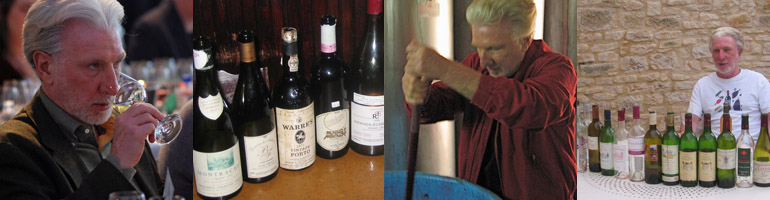
Recently, the renowned Michelin Guide announced that they would be publishing a new guide devoted to wines. But their new rating system does not apply to individual wines, but to the wineries themselves. This raises a lot of questions about their system and how it will affect the wine industry which Daniele Cernilli, aka Doctor Wine, discusses at length. Read his article on the subject below.

Michelin-starred wineries
by Daniele Cernilli, 15 December 2025
The arrival of Michelin in the wine guide industry introduces a “starred” rating system applied to wineries and not to individual wines. A choice that opens up questions: how will wineries with large productions be evaluated? How will this method be reconciled with those who have been using stars for years? And what role will The Wine Advocate, already acquired by Michelin, play?
Michelin launches wine guide: starred wineries
The news of recent times in the wine world is that of Michelin’s descent into the field.
The “redhead” will publish a wine guide, using its well-known “stars,” but not rating individual wines, but rather wineries. They will be “starred” in the same way that restaurants are, rating them with zero, one, two or three stars, while individual wines will be considered like dishes in the restaurant guide.
Stars in wine: a story from afar
I would then add that Michelin, which was definitely the first to use star rating for restaurants, is not at all for wines.
Veronelli began in the 1960s with the Bolaffi Catalogue of the Wines of Italy, where stars were used on wines.
Continued Gambero Rosso and Slow Food on Wines of Italy, where for every ten “three glasses” a star was awarded to the winery this time.
Even DoctorWine for the past twelve years has been using stars in exactly the way Michelin will do, awarding “three stars” to wineries and not to wines, rated in cents and “veneers.”
A possible “pre-use” conflict?
What will the “redhead” do in the presence of a kind of “pre-use right”?
Will you open litigation or, more appropriately, pay no attention?
Certainly DoctorWine’s Three Stars has been around for a long time and may even become a publication, who knows.
What role will The Wine Advocate?
Then, Michelin had not taken over The Wine Advocate by Robert Parker? What role will that publication play in the future? Of course, it is a newsletter and not a guide, however, always wine is being talked about and always Michelin is the publisher.
We shall see in this case, too, evidently.
Michelin-starred wineries are wineries rated using a star system, similar to that used for restaurants. The guide assigns zero to three stars to wineries, considering the overall quality of production and not individual wines.
How the Michelin-starred winery system works:
- Stars are awarded to wineries, not individual wines.
- The rating ranges from zero to three stars.
- Wines are examined as part of the winery’s overall production.
- The goal is to make a judgment about the overall level of the company.
What does Michelin rate in wineries?
Consider the overall quality of production, the consistency of the wines, and the winery’s ability to maintain high standards over time.
Why does Michelin award stars to wineries and not to wines?
Because the focus of the guide is on the overall level of the company, similar to the approach used for restaurants.
Is it possible for a large company to be penalized?
Yes, because a very large production sometimes includes ranges intended for less prestigious segments, making it more difficult to achieve the highest score.
Is Michelin the first to apply stars to wine?
No. Stars were used as early as the 1960s by Veronelli and more recently by others such as DoctorWine.


 There were 10 wines: 3 whites, 6 reds and a Moscato d’Asti.
  The wines to be tasted
  Moscato d’Asti DOCG NV made from 100% Moscato di Canelli (Piedmont ) Luca Bosio. The vineyards are at 200/300 meters and the training system is guyot. Soil composition is clayey calcareous. Vinification takes place without the skins for 5 days in steel tanks at low temperature (15 C) The wine ages for 2 months on its own yeast. Total residual sugar is 130g/l. The wine has hints of citrus fruit, apricot, pineapple, peach and honeysuckle. $18
 Salchetto “Nobile” 2018 made from 100% Prugnolo Gentile on 15 ha. Each plant makes one bottle. Manual harvest, sulfite free vinification with native yeasts takes place.


