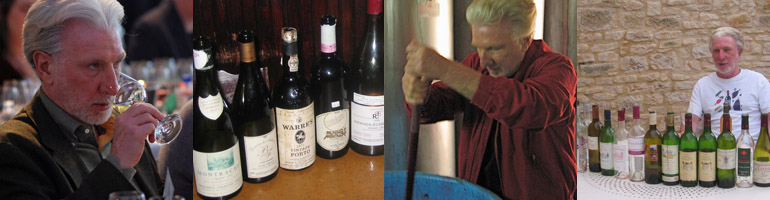
I met Emidio Pepe, one of my favorite wine producers, a few times both in NYC and at Vinitaly, the wine fair in Verona, but I never had the chance to visit his winery in Abruzzo, even though I have been to the region many times. I started drinking Montepulciano d’Abruzzo many years ago with vintages from the 1970’s and they quickly became one of my favorite wines.
In early June I was invited on a press trip by the Consorzio Vini d’Abruzzo called the Abruzzo Wine Experience. It included visits to a number of wineries and one of them was the Emidio Pepe Winery. At last I would have my chance.
 When we arrived at the winery we were met by Emidio and his granddaughter Chiara De Julis. I had known Chiara as the public relations person for the winery in NYC.
 Chiara took the group to view the vineyards and spoke about the land. The soil is clay and limestone with the top 40 centimeters in clay on a solid layer of limestone. She said they use both the tendonne or pergola method for the Montepulciano and Trebbiano varieties and the cordon spur method for the Pecorino for training the vines. Chiara explained that “the pergola is like a solar panel to my grandfather: the greater sun exposure guarantees more photosynthesis so a ratio in favor of energy production and accumulation of reserves, keeping the evolution of the berries slow and gradual. The ripening of the Montepulciano under the shade of its leaves is the key to the elegance of its tannins; the pergola is the promise today, as an ancient visionary resolution facing today’s challenging climate.”
Chiara continued, “Our wines’ sense of place is strongly tied to the genetic complexity of the vegetal material which populates our vineyards. Emidio planted his first vineyards with the old method of field grafting. This practice – long lost – is to plant the rootstock, leaving its root system to dig deep in search of nourishments without worrying about the fruit. When ready, the plant is then grafted in the field, an operation that Emidio did himself after having selected and prepared every bud.”
According to Chiara, 1 hectare of tendonne has 900 vines and produces 90 quintals of grapes. That means that each vine produces from 6 to 9 kilos of grapes. In one hectare of cordon spur trained grapes, there are 3,300 vines and each vine produces 5 to 6 kilos of grapes.
After our tour, Chiara invited us to dinner.
 The dinner menu
 Over dinner Chiara spoke about the wines. She began by telling us that her grandfather’s first bottled vintage was in 1964 and at that time he had only one hectare of vines. Today there are 17 hectares of vines near the Adriatic Sea that stretch out over the Teramo hills at the foot of the Gran Sasso Mountain.
The Emidio Pepe winery is Organic and Bio-Dynamic. They belong to the Triple “A”– Agriculturists Artisans Artists, an association of wine producers from around the world that believes in Organic and Bio-Dynamic production, terroir, and as little interference as possible by the winemaker in the winemaking process. Only natural yeasts are used. This gives the wine more complexity because there are so many different strains of yeast on the grapes and in the air.

The white grapes are pressed by feet in the wooden tub in the front and the red grapes by hand in the one in the back.
Trebbiano d’Abruzzo — the picking is exclusively by hand selecting only the perfect grapes. The white grapes are crushed by feet in a big wooden tub, 350kg at a time get crushed for 40-45 minutes, allowing a constant stimulation of skin with the juice, letting the skin release matter, flavors and aromas.
This method allows them to press the grapes in a delicate and soft way, not letting the stems break and producing a rich must ready to ferment. Only the juice goes to ferment in small concrete tanks, where spontaneous fermentation will start and go on for 30-35 days. From the concrete tanks, the second spring following the harvest, the wine will go straight into bottle to start its long improvement.
Montepulciano d’Abruzzo — the grapes are hand destemmed on a net on top of a wooden vat, two people push the grapes back and forth until the berries fall down and the stems remain on the net unbroken. This way only the elegant and juicy tannins of the skin will go into the must but not the bitter ones from the stems. The berries remain almost intact, important to keep the yeasts which are on the skins and really precious to the spontaneous fermentations.. No sulfites are added to the wine. The juice is placed in glass lined cement tanks of 20/25hl. The white remains here for one year and the red for two years. The wine is then transferred to bottles by hand.
The winery also produces a Cerasuolo (Rosé) which does not have any skin contact. It is made from the juice of the Montepulciano grapes which are pushed back and forth by hand.
 The wines made from the younger vines are released early for the Italian market. The wines made from the older vines are left in the winery to age and and then released on the international market. Chiara said the young vines do not have the the body or complexity to make to overseas journey.
 Starting in 2018 with the 2010 vintage, the aged wines will have Selizione Vecchie Vigne on the label.
Chiara’s grandmother Rosa Pepe is in charge of the decanting process. Since this is a natural wine malolatic fermentation may take place in the tank or the bottle. There is no filtration or fining. The corks are placed in the bottles by hand and only the best cork is used. Chiara said that they guarantee all of the bottles have been decanted at the cellar after 20 years, no matter if the vintage is 2003 or 1983. The wine has to be well balanced and decanted to manage the trip and only their best wines are sent to the USA and put on the market.
About 60,000 bottles a year are produced. In an exceptional vintage they will hold back 70% of the production.
Chiara said that they have 600,000 bottles of wine from 1964 to the present vintage.
 We tasted Trebbiano 2019, 2009, 2013, 2004 – While I like the older vintages I prefer the younger ones.
We tasted Montepulciano 1983, 2001, 2002, 2003, 2007- Recently in Rome I had the 2016 vintage and it was wonderful. However these are wines that can really age and their true greatness is expressed in the older vintages.
 The last wine we tasted was the 1983 Montepulciano D’ Abruzzo. Chiara said at first her grandfather did not like the 1983 vintage so he kept it in his cellar and did not sell it. A journalist came for a visit and asked why there was no 1983 on the market. When Emidio explained, the journalist asked if he could try it. Emidio agreed and they tasted it together. The wine had developed in the bottle and the two decided that it was a great wine in a great vintage. Emidio put 30% of the 1983 on the market. I was very happy Chiara let us taste this wine. I have had the 1963 a few times over the years and all I can say is that it is in a league of its own.
I consider myself very fortunate to have been able to taste so many vintages of the great wines of Emidio Pepe all at one time.
 I have visited Abruzzo a number of times and have always enjoyed the wine and food. In fact some of my favorite wines are produced there.
 On the first night we visited had dinner in a trabocco. Fishermen traditionally built these wooden sheds onto piers that jut far out from the shore as a place to catch fish when the weather was bad.
 The one we visited had been converted into a restaurant the, Trabocco Punta Cavalluccio. Davide Acerra, president of the Consortia Tutela d’Abruzzo, welcomed us and spoke about the Abruzzo Region.

 Sautèed Mussels
 Verrigni fusilli with cuttlefish, glasswort and turmeric scented bread crumbs
 We also visited the town of Loreto Aprutino which was know for its olive oil production and there is a Olive Oil Museum there in a Gothic building dating from 1881. Unfortunately the museum was closed.
 Stefania Pepe “Pepe Rosa” Montepulciano d’Abruzzo Cerasuolo DOC Biologico 2017. Made from 100% Montepulciano d’Abruzzo. The exposure is southeast. The training system is the pergola abruzzese. Fermentation takes place in temperature controlled stainless steel vats, without the skins, only the juice. This is a fresh fruity rose with red fruit aromas and flavors and hint of cherry. I have been a big fan of Stefania’s wines for many years.
 Talamonti Trebbiano d’Abruzzo Riserva made from 100% Trebbiano di Abruzzo. The soil is stony, calcareous, structured and drained. The vineyard is at 300 meters. Harvest is by hand in mid September. Stalks are removed and the grapes undergo a cold maceration followed by a soft pressing. The clarified must is fermented on temperature controlled stainless steel vats for 12 days. The wine is aged for 7 months in 300 liter oak barrels (30%) and stainless steel (70%) with repeated badinage before bottling. The wine has hints of citrus fruit, apple, spiced good acidity. This is a white wine that will age. The president of the winery is Rodrigo Redmond. Before the tasting he recognized me from his time in NYC and we spoke. I did not know he had a winery and I was very impressed by the wines.
 Tenuta I Fauri Abruzzo Pecorino DOC 2017 made from 100% Pecorino. The soil is clay calcareous and the training and pruning methods are tendone, single curtain/rows (spur training). There are 1,600/3,000 vines per hectare. Static decanting of the must takes place, followed by a soft pressing. Fermentation is in stainless steel at a controlled temperature and the wine is aged in stainless steel. The wine is bottled at the end of February. The wine has hints of apple and honey and a touch of mint. I visited the winery a few years ago and really liked the wines.
 Fattori Nicodemi “Notàri” Trebbiano d’Abruzzo made from 100% TrebbIano d,Abruzzo. The vineyard is at 300 meters and the exposure is north/east. The training system is pergola Abruzzo and there are 1,600 vines per hectares. The vines are 50 years old. Harvest takes place the second half of September. Vinification is for 15 days in stainless steel at a controlled temperature. The wine remains on the lees for 6 months with bàtonnage. The wine remains in bottle for 6 months before release. The wine has hints of apricot, and hazelnut with a note of green olives and touch of mint.
 Philipponnat “Les Cintres” 2008 Extra Brut made from 100% Pinot Noir. First press juice from the central plots: Les Grands Cinders and Les Petits Cintres in Clos des Goisses, Mareuil-sur-Ay. Vinification using traditional methods to avoid premature oxidation, with no malolactic formation. All the wines are fermented in casks. Extra brut dosage of 4.5g/litre.
 Chateau Haut-Brion 2005 made from 52% Sauvignon Blanc and 48% Sémillon from a little less than 3 hectare plot. 2005 was a great vintage similar to the legendary vintage of 1949. Conditions were so perfect that the vines were able to produce small grapes of an extraordinary concentration that were harvested in perfect condition. Fermentation is done in oak barrels for a period of 9 to 12 months of which 50% of the barrels are new.
 Volnay 1er Cru 2013 Hospices de Beaune made from 100% Pinot Noir
 Local Green Asparagus & Coppa dressed with lemon, black pepper, Parmesan, and olive oil
 Bonnes Mares Grand Cru 2001 Domaine Fougeray de Beauclair from 25 to 75 year old vines in clay and limestone soil. There is 3 days cold maceration followed by alcoholic fermentation at a controlled temperature. The vatting time is between 2 and 3 weeks. The wine is aged in new barrels for 18 months. This is a wine that has great length with hints of blackcurrant, blackberries, violets and a note of red berries.
 Spaghetti à la Marseilles — pasta with a sauce of crab, mussels, prawns, tomato, saffron and white wine
 Chambertin 2002 Domaine Bouchard Père & Fils made from 100% Pinot Noir. Manual harvest in small crates followed by an intense sorting of the grapes. There is a total or partial destemming depending on the vintage. After a gentle pressing fermentation is in small containers. Vatting is for 12 to 15 days and aging for 10 to 18 months in French oak barrels with 60 to 85% new.
 Duet of Lamb–grilled marinated lamb tack, Merguez, carrot puree, chanterelles, favas, lamb jus.
 Chateau Haut-Brion 1970 made from Merlot, Cabernet Sauvignon and a lesser amount of Cabernet Franc. This is a full bodied elegant wine
 Duca Enrico IGT 1986 Duca di Salaparuta (Corvo) made from 100% Nero d’Avola grapes grown in South Central Sicily. Soil is a mixture of calcareous-siliceous composition. The vineyard is at 200/300 meters and the vines are bush trained. There are at least 5,000 plants per hectare. Grapes are hand picked at full ripening and then destemmed. Maceration at 28/30 degrees for 8/10 hours followed by malolactic fermentation. The wine is aged in oak casks for 18 months and then 18 months in bottle before release. First vintage was 1984 and it was the first 100% Nero d’Avola to be bottled in Sicily.
 Blackberry Sorbet with toasted honey oats
 Rhubarb Gateau, Vanilla Creme Anglaise, Cherry ice cream
 All of the wines all in a row with some of the members.