Category Archives: Italian Sparkling Wine

First Look Series: The Barollo Brothers

Gary Grunner of Grapes on the Go invited me to the first event of his First Look Series. Held at the Manhattan Club, a private club in NYC, the First Look Series features wineries that Gary will be importing over the next year.

Barollo Brothers, Nicola and Marco

Barollo Brothers, Nicola and Marco

The wines for this first event were from the Società Agricola Barollo Marco e Nicola. Marco Barollo represented the winery. The winery is located in Preganziol, near Treviso in the Veneto. It is near the Adriatic Sea and the Dolomites are visible in the background.

Marco Barollo speaking at the tasting

Marco Barollo speaking at the tasting

Marco said that 45 hectares are planted with vines.The grapes are harvested by hand and it takes about 20 workers to pick the grapes from one hectare of vines in a day. The wine presses are located near the vineyards so that the grapes remain intact right up to the time they are pressed.

Marco said that his wines reflect the terroir and the grapes that they are made from and therefore go very well with food. All the wines are fermented in 300HL stainless steel tanks. There was only one wine that was in barriques which were made of Allier oak by a barrel maker in Burgundy.

The goal of the winery is to reduce their ecological footprint and CO2 emissions.IMG_6389

Sauvignon Blanc 2013 100% Sauvignon Blanc. There are 5,080 vines per hectare, the grapes are hand harvested. Soft pressing, settling, traditional fermentation in temperature controlled stainless steel tanks. Three months in bottle before release. This is a subtle Sauvignon Blanc, with nuances of grapefruit, lime, current, citrus and herbal notes of grass and minerals. A slight trace of tomato leaf can be found in the finish. The wine was served with cold poached shrimp, yellow squash, baby kale, tomato confit and champagne vinaigrette. The wine and food matched very well, especially since kale can be very hard to match.IMG_6395

Pinot Bianco 2012 100% Pinot Bianco. The training system is spurred cordon and there are 3,000 vines per hectare. Harvest takes place in early September. Soft pressing takes place, settling and traditional fermentation in temperature controlled stainless steel vats with daily batonnage. The wine remains in contact with the lees for an extended period of time. The wine is aged for 6 months in stainless steel and 6 months in bottle before release. This wine is fresh and elegant with a pale yellow color. The bouquet is fruity, with a dominant note of apple and tropical fruit. It has good acidity, a mineral character and a long-lasting finish. This was served with pumpkin risotto drizzled with pumpkinseed oil. $18 IMG_6394

Manzoni Bianco 2012 100% Manzoni Bianco. There are 5,000 vines per hectare and the harvest takes place in the middle of September. There is a soft pressing of the grapes, part is fermented in temperature controlled stainless steel tanks and part is barrel fermented with daily batonnage. The wine is in bottle for 6 months before release. Marco said that this white wine is the exact replica of one of the most famous wines created and developed by Professor Luigi Manzoni, Dean of the Winemaking School in Conegliano. Manzoni conducted a series of experiments in the 1930s on genetic improvements to the grape through crossbreeding and hybridization. Manzoni Bianco, an indigenous grape from the province of Treviso, was created by the genetic crossbreeding of Riesling Renano and Pinot Bianco.

The wine has a golden yellow colour; it is fruity with floral notes and hints of apple with good acidity and a pleasant minerality. This was also served with the risotto and it worked very well with it but I gave a slight nod to the Pinot Bianco. $19

Frater Red 2013 100% Merlot (Frater means brother in Latin) The training system is spurred cordon, there are 3,700 vines per hectare and the grapes are hand harvested the last week of September. Maceration and fermentation lasts for 12 days in temperature controlled steel vats with daily pumping over, devatting and malolactic fermentation taking place. The wine is in bottle for 3 months before release. This is a balanced well-structured wine, with hints of ripe red cherries, a touch of spice and a nice fruity finish and aftertaste. This was served with grilled hanger steak caramelizes onion and oxtail marmalade. $17 IMG_6384

Frank 2010 100% Cabernet Franc There are 5,100 plants per hectare and the grapes are hand harvested the last week of September. Maceration and fermentation lasts for 15 days with daily pumping over, devatting and malolactic fermentation taking place. The wine is aged for 12 months in barriques, of Allier oak, 1/2 new and 1/2 second passage and in bottle for 6 months before release.
This wine is made with grapes from some of the world’s oldest vineyards. This is an elegant well-balanced wine with hints of ripe berries, coffee and a touch of tobacco. It has a very long finish. This was also served with the hanger steak. $30IMG_6393
Prosecco DOC Treviso NV made from100% Gela from manually selected grapes. The soil is medium grained with limestone and clay. Training system is the syloz, this is a trellising system where the canes bend downward a few weeks before the harvest. There are about 2,700 vines per hectare. Harvest takes place the first week of September. The Charmat method consisting of a natural fermentation in bulb tanks takes place and lasts for 90 days. Aging is for another 3 to 4 months. The wine has a light golden yellow color with hints of acacia flowers and fresh aromatic notes of yellow apple and peach. It has a nice fruity aftertaste. The Prosecco was served with a mini pastry platter consisting mostly of little bites of chocolate. It was unusual to serve the prosecco last but it made a very refreshing end to the meal and went very well with the chocolate.

This was an enjoyable tasting with wine and food pairings that were well thought out. I am looking forward to the next event.

Leave a comment

Filed under Cabernet Frank, Italian Red Wine, Italian Sparkling Wine, Italian White Wine, Italian Wine, Manzoni, Marco and Nicola Barollo winery, Merlot, Prosecco, Sauvignon Blanc

Metodo Classico Lambrusco and Negroamaro

This week I tasted two sparkling wines made with what the Italians call metodo classico, the Champagne method. One was a Lambrusco, a wine I am very familiar with but this was the first time I tasted one made in this way. The other was made with Negroamaro, a familiar grape variety, but not as a sparking wine and certainly not by the Metodo Classico.IMG_6018

Lambrusco di Modena Spumante Brute Metodo Classico DOC 100% Lambrusco di Sorbara- Cantina Della Volta (Emilia Romagna). This red wine is obtained by a selection of the best Sorbara grapes entirely gathered in small cases (max. 37 lbs.) by manual harvesting. The grapes are carefully handled in order to prevent them from being crushed during transportation to the winery. The clarification of the must is followed by fermentation at controlled temperature in stainless steel tanks. After resting for at least 6 months the wine receives selected yeasts prior of being bottled. The bottles are then stored horizontally in piles for the re-fermentation process in a constant ambient temperature of 53°F. The last steps are the remuage, disgorgement and the addition of liqueur d ’expedition. This is a dark red wine with wild strawberry aromas and flavors and hints of other red fruits and berries.IMG_6029

 Salento IGT Spumante Brut Rose “Noitre” Metodo Classico 100% Negroamaro from Salice Salentino-Futura 14 (Puglia). The vineyard is at 40 meters and the soil is clayish and sandy. The training system is spurred cordon. There are 5,000 vines/ha and the vines are 12 years old. Harvest is the last week of August. Alcoholic fermentation takes place in stainless steel and there is a partial malolactic fermentation. The wine rests in the bottle for 30 months before release. It is a very light salmon color with  red fruit aromas and flavors and hints of raspberries. Part owner of Futura 14, the company that makes the wine, is Bruno Vespa, a well-known Italian TV personality.


3 Comments

Filed under Cantina della Volta, Futura 14, Italian Sparkling Wine, Method Classico, Sparkling wine, Spumante

Donnachiara at The Leopard at des Artistes

Along with 6 other journalists I was invited by Ilaria Petitto to the Leopard at  des Artistes for a Donnachiara Campania Wine Workshop.  Ilaria is the 5th generation female to run the estate and is in charge of all operations.

Ilaria Petitto

Ilaria Petitto

The workshop was held in the restaurant’s cozy private dining room.  We tasted and drank the wines of Donnachiara and discussed the region of Campania and its wine.  We spoke about what people think when the hear Campania:  the Amalfi Coast, Naples, Pizza, Wine, etc., were cited.  It was the consensus that Campania produces the best white wine in Southern Italy and certainly has the most interesting white grape varieties. The importance of the Aglianico grape and Taurasi was also discussed.

Iliara then told us about the wines that she had chosen to match with the menu.

IMG_4942

Falanghina Beneventano Santè Brut IGT 100% Falanghina.  Ilaria said that the vineyard is in Torre Cuso, the best location to grow Falanghina.  The soil is volcanic chalky clay.  There are 2,500 plants per hectare and the harvest takes place the first week of October.  Fermentation lasts for 40 days. Illaria referred to the production method used as the Martinotti method for sparkling wine (The Charmat method, as it is more popularly known, was invented by Federico Martinotti in Asti in the 1920’s).  Refermentation takes place at low temperatures in autoclaves for about 6 months. Then the wine matures on the dregs for another 2 months. The wine had very good bubbles; it was fresh, delicate with floral and citrus aromas and flavors. It was the perfect wine for the appetizers which were very much in the tradition of Campania.

IMG_4907

Falanghina Beneventano 2012 DOC 100% Falanghina the vineyard is the Torre Cuso, the best location for Falanghina. The soil is Volcanic, chalky clay, the vines are 16 years old , the training system is guyot and there are 2,500 vines per hectare. The grapes are not destemmed or crushed befor pressing. Cold fermentation is in stainless steel and there is extended maceration. This is a crisp white wine with citrius fruit amomas and flavors nice acidity and good minerality.

With the first two wines we had: crisp fried zeppole, potato croquettes known as panzerotti, miniature mozzarelle in carrozze and bite size pieces of torta Pasqualina, a spinach and ricotta pie.

IMG_4909

Greco di Tufo 2010 DOCG 100% Greco di Tufo The soil is tuffaceious and the training system is espallier. There are 3,300 plants per hectare and the harvest takes place during the second week of October. Illaria said that the grapes come from highly rated vineyards. The grapes are not destemmed or crushed prior to pressing. Cold fermentation with extended maceration. No oak used. This is a wine that needs at least 5 or 6 years of bottle age  before it is ready to drink, she remarked. This was served with the Parmigiana di zucchine con scamorza e salsa al pomodoro and it was a perfect combination. The wine was just starting to come around, it has nice citrus aromas and flavors, a hint of smoke and a touch of almonds in the finish and aftertaste.

IMG_4908

Fiano di Avellino DOCG 2007. 100% Fiano.   The soil is chalky clay and the training system is Guyot. There are 4,400 vines per hectare and the 4 hectare vineyard is located at 600 meters.  Harvesting takes place during the second week of October. llaria said that 2007 was a very hot and dry vintage that produced a very concentrated wine with scents ranging from candied fruits to flora. She believes the aging potential of the wine is 15/20 years and I agree. This is a wine with good structure and body. There were floral notes, aromas and flavors of citrus fruits, good acidity and a hint of smoke. This was an excellent compliment to the Scialatielli ai frutti di mare, short strips of homemade pasta typical of Amalfi in a seafood and tomato sauce.

IMG_4906

Greco di Tufo IGT Ostinato Campania  2011 100% Greco. This single vineyard is 4 hectares and it is outside the DOCG zone in Venticano, Torre Le Nocella.  The soil is clay and limestone.  The age of the vines is 20 years, the training system is Guyot and there are 5,000 plants per hectare. A late harvest takes place the first half of November. The grapes are not destemmed or crushed prior to pressing.  Fermentation is for 12 months 20% of which is in French barriques. The wine is naturally clarified and there is no refrigeration or filtration at bottling. The first time I drank this wine I had it with pasta and clams and it was a terrible combination. The label said Greco di Tufo, but it tasted like a dessert wine. At the workshop dinner, it was served with crostino di pane ciabatta con fegato grasso, toasted ciabatta bread with foie gras.  The combination was sensational, since like certain dessert wines, it goes well with foods like foie gras or cheese.

I told Ilaria that I found this wine to be very confusing since there is no indication on the bottle that it is a dessert wine.  She said that it is in a smaller bottle (500ml), the bottle is clear so you can see the darker color. I said that this should be clarified on the label for the sake of the consumer.

IMG_4905

It becomes even more confusing because of the next wine, the Esoterico Campania Fiano 2011 IGT 100% Fiano.  The soil is volcanic, chalky clay, the age of the vines is 6 years, the training system is Guyot and there are 4,400 vines per hectare. Everything else is done just like the Greco except the final result is different. The wine is light in color and while it has more body  than the regular Fiano, it does not really taste like a dessert wine.   I would not drink it with fegato grasso.

Ilaria said that the Greco was darker in color and more like a dessert wine because of the nature of the Greco grape. In both cases it is not the wine I have a problem with, but the labeling, which needs to be clearer

IMG_4904

Taurasi DOCG 2007, 2008 and 2009. 100% Aglianico coming from the 20 hectare estate vineyard Torre le Nocelle. Ilaria said that all of Donnachiara’s red wines are made from grapes from this vineyard. The soil is volcanic, the vines are 30 years old, the training system is Guyot and there are 4,000 plants per hectare. The grapes are not destemmed or crushed prior to pressing and there is no filtration. The wine is aged for 12 months in 225-liter French barriques. I find these red wines to be more modern in style but not over the top and they all needed more time.IMG_4900

It was served with costata di manzo alla griglia con sale rosa cristalino dell’Himalaya e pandellate di Friarielli e patate, grilled rib eye steak with Himalayan pink salt, broccoli rabe and potatoes. The wine worked much better with the steak, which was so good that I ate the

5 Comments

Filed under campania, Donna Chiara Winery, Falanghina, Fiano, Italian Red Wine, Italian Restaurants, Italian Sparkling Wine, Italian White Wine, Italian Wine, Taurasi, The Leopard at Cafe des Artists

First Look at a New Import!

Tasting wines from a producer that I do not know is always very interesting.  Two brothers own the winery and it bears their name:  Società Agricola Marco & Nicolass Barollo.

IMG_4272

Marco Barollo

Located in the Veneto near the town of Treviso, it was purchased by the brothers in 2001. There are 45 hectares of vines and they produce 300,000 bottles annually. These wines will not be imported in the U.S until January, so this is a first review of a new winery that has joined the Grapes on the Go fine wine portfolio for 2014.

I was invited to a tasting and lunch at SD 26 in NYC by Gary Grunner, president of Grapes on the Go.  Representing the winery was Marco Barollo, an owner and the export manager.

The WinesIMG_4269

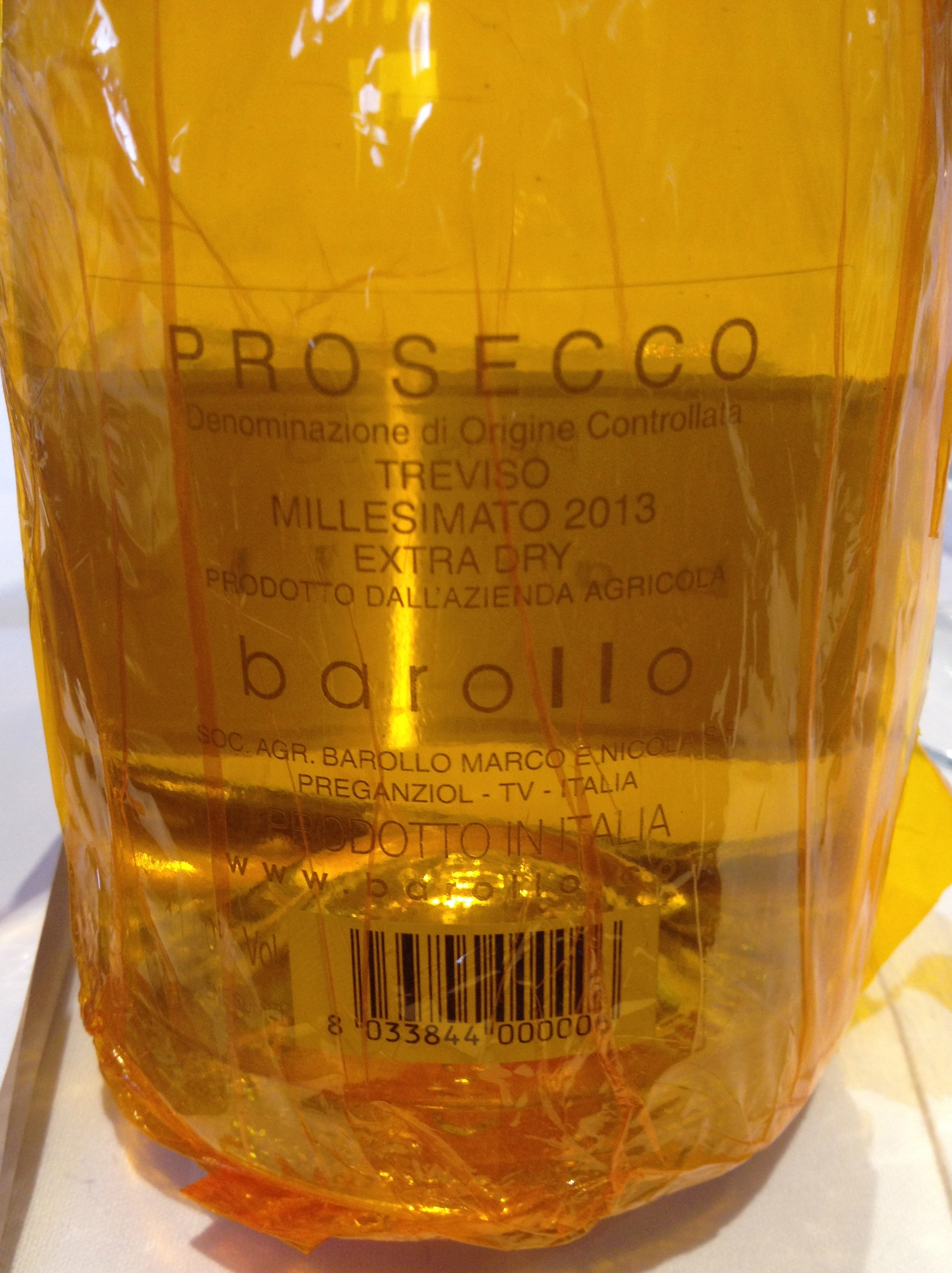
Prosecco Brut DOC Treviso NV 100% Glera. The soil is medium-grained, limestone and clay, the training is by the sylvoz system (horizontal shoot from which fruit branches curve downward) and there are 2,700 vines per hectare. Harvesting of the grapes takes place the last week in September. The Charmat method is used, consisting of a natural fermentation in bulb-tanks for 90 days. Aging is 3 to 4 months. Marco said that the Charmat method produces smaller longer-lasting bubbles. The wine is kept at a low temperature and they only use as much as they need so the Prosecco is always fresh and is bottled all year round.

Marco said that it could have been labeled Extra Dry because the residual sugar falls exactly between the two classifications (12 grams). This is an elegant Prosecco, with small bubbles, citrus aromas and flavors, hints of apple and white peach and good acidity. The bottle is wrapped in yellow cellophane, which makes for a sophisticated presentation.  $16IMG_4267

Pinot Bianco 2012 IGT Venezie 100% Pinot Bianco. The training system is spurred cordon and there are 3,000 vines per hectare. Harvesting of the grapes is by hand in early September. Soft pressing of the grapes is followed by a settling, traditional fermentation in temperature controlled stainless steel tanks. There is daily batonnage. Marco said that the wine remains on the lees for 6 months and 6 more months in bottle before release. Wines made in Italy from the Pinot Bianco grape have not gotten the attention they deserve in this country. They are excellent white wines and are very reasonably priced. This one is crisp and dry with citrus fruit aromas and flavors, a hint of apple, a floral characteristic and very good acidity that makes it an excellent wine with food.   $16IMG_4268

Frater 2012 Doc Piave 100% Merlot The training is low-spurred cordon with 3,570 vines per hectare. Temperature controlled fermentation and maceration lasts for 12 days. Daily pumpovers, devatting and malolactic fermentation take place. The wine is aged for 3 months in bottle before release. Marco said that this wine showed the true character of Merlot from the Veneto. This is a medium bodied soft and velvety wine that has the aromas of the grape that it is made from. There is good fruit with hints of cherry, currants and a touch of blueberry. I was very impressed with this wine and it just kept on getting better and better in the glass.  $16IMG_4266

Frank IGT Veneto 2010 100% Cabernet Franc. The training system is spurred cordon and there are 5,100 vines per hectare. Harvest is by hand at the end of September. Temperature controlled fermentation and maceration, followed by devatting and malolactic fermentation. The wine is aged in Allier barriques 50% new and 50% one year old and 6 months in bottle before release. Marco pointed out that the wine did not have any of those ‘green’ flavors and aromas often found in Cabernet Franc from Italy. The wine has hints of vanilla, raspberry and cassis with a touch of pepper, it is international in style but not over the top.  $18

I believe that all of these wines are an excellent value for the money!

Leave a comment

Filed under Italian Red Wine, Italian Sparkling Wine, Italian White Wine, Italian Wine, Prosecco, Societa Agricola Marco&Nicolass Barollo, Veneto

Celebrating My Birthday

My birthday celebration this year began the night before. Alfonso Cevola, a friend and fellow blogger “On the Wine Trail in Italy,” was visiting from Texas and we met at La Pizza Fresca for dinner.  We had two wines.

Sciac-trà Ormeasco di Pornassio 2011 DOC GuglierameIMG_3731

I was given this bottle of  Sciac-trà from Liguria for my birthday.  It was one of the most interesting rosato wines I have ever tasted.  It is made from the Ormeasco grape, which is the local name for the Dolcetto grape.  It is vinified in the traditional way.

The wine must be produced from at least 95% Ormaeasco and 5% of other approved red grapes. The grapes are grown on steep slopes high in the mountains at 800 meters. This grape is an early ripener and I believe the name means “crushed before the others.” It is aged for 4 months and does not see any oak. The wine comes from the Rivieradi Ponente in northwestern Liguria and should not be mistaken for the sweet Sciacchetra from the Cinque Terra area of Liguria. It has lively fresh red fruit flavors, a nice finish and a pleasing aftertaste.

The other wine of the evening was my favorite Chianti, Chianti Rufina Riserva 1990 Villa di Vetrice. The wine is made from 100% Sangiovese and there is traditional vinification. The wine is aged in large botti–oak barrels between 45 and 60 HL. The wine was showing no signs of age and will last for a number of years. It is Chianti at its best!

For my birthday dinner, I asked Michele to make some of my favorite food.IMG_3746

When I am in Rome the first I do is head for a restaurant that makes fried zucchini flowers stuffed with mozzarella and anchovies.  I love them.  Since I am not in Rome, Michele and I went to the Greenmarket in Union Square and brought a box containing a dozen zucchini flowers.  When we returned home Michele wanted to know how many she should make and I said all of them.  IMG_3751

When in Rome I drink Prosecco with the flowers but Alfonso had given me a bottle of Franciacorta Grand Cru Pas Opere 2006 Bellavista for my birthday so I decided to try that.

It is made from 62% Chardonnay and 38% Pinot Noir. The vineyards are on high hills facing south and southeast and the average age of the vines is 20 years.  The wine is aged for 6 years in the cellars and it sees some small oak barrels.  The wine is big and round with nice fruit flavors and good bubbles.

For the next course, Michele made my favorite pasta, bucatini all’Amatriciana, thick tubular pasta strands with a tomato sauce with guanciale or pancetta, and pecorino cheese.  With it we drank IMG_3755Taurasi  “Radici “1995 Mastroberardino DOCG, 100% Aglianico grapes.  The vineyards were on two hills, Mirabella vineyard at 500 meters and the Montemarano vineyard at 550 meters. Because of its position on the hill and its altitude the temperature at the Montemarano vineyard was much colder and the grapes are picked a little later. Harvest takes place from the end of October into the beginning of November. The vinification is the classic one for red wine, long maceration with skin contact at controlled temperatures. The wine is aged for 24 months in Slovenian oak barrels and remains in the bottle for 24 months before release.  This is full, complex wine with hints of black cherry, plum, spice and a touch of leather.IMG_3754

Foe dessert there was a blueberry crostata!

15 Comments

Filed under Bellavista, Franciacorta Brut, Italian Sparkling Wine, Italian Wine, Ormeasco di Pornassio, Sciac-tra

With A Little Help From My Friends

The Westchester Italian Cultural Center is located in Tuckahoe about a half hour by train from Grand Central. The center preserves, promotes and celebrates the rich heritage of classical and contemporary Italian culture by encouraging an appreciation of the Italian language, arts and letters, history, cuisine and commerce through educational programs, exhibits and events.  Patrizia Calce, the director of events for the center, asked me if I would do a wine and food tasting for members and their guests featuring Wines and Foods of Northern Italy.   IMG_2809 I was more than happy to do so but I explained to Patrizia that I would need a little help from my friends.  The first one I called was Gary Grunner of Grapes on the Go, a wine importing company.  Gary said he would donate the wines of Tenuta Santa Maria in Pieve in the Veneto and would also attend the event to say a few words about the winery.  Gary then asked Douglas Giachino of Vinvino wines if he would supply the wines of Andrea Oberto from La Morra in Piedmont.  Vinvino also distributes the wine of Tenuta Santa Maria della Pieve for Gary and Giachino agreed to help, too.

Last but not least I asked Louis Coluccio of A.L.C. Italian Grocery in Bay Ridge Brooklyn to supply the food.
Louis replied “Just tell me what you need.”  A.L.C. sells both top quality imported Italian food products and prepared foods to take away.  It is the closest I have come to an Italian food shopping experience in the New York area. IMG_2820
With so much cooperation and great wine and food lined up, the tasting at the WICC was a sure success.  Over 40 members and guests attended.

The Wines
Prosecco NV 100% Gela-formerly known as Prosecco, Luccio.  The grapes come from the rolling hills of the Veneto countryside just north of Venice and are harvested by hand. A soft pressing occurs and the juice is placed in stainless steel tanks. Before the primary fermentation process is concluded, the wine is run into a pressurized tank where a secondary fermentation takes place allowing it to become a sparkling wine.IMG_2812Soave “Lepia” 2010 IGT made from 100% Garganega Veronese. Tenuta Santa Maria Della Pieve The soil is clay with calcareous-marly subsoil. The training system is the pergoletta, and there are 3,800 vines per hectare. The grapes are harvested in September at different times of ripening and crushed separately, with cold pre-fermentation skin contact. The grapes are gently pressed and fermented. The wine is blended in January and racked in stainless steel tanks with the thin lees. Then there is a short bottle refinement. The wine has flavors and aromas of pears and peaches with a hint of almonds and nice minerality. I like this Soave because it reflects the indigenous grape and the terroir. $22IMG_2813Gavi “IL Mandorlo”  2011 Tenuta San Pietro 100% Cortese.  The winery is organic and biodynamic. Soil is limestone-clayey with a good mineral content and the vineyard is at 300 meters. The grapes are hand harvested in the middle of September. Soft crushing is followed by fermentation in temperature controlled stainless steel tanks using natural yeast from the cellar. This is a well-balanced wine with floral hints, fresh fruit aromas and flavors and good acidity.  $16IMG_2816
Dolcetto d’Alba 2010 Andrea Oberto-La Morra, Piedmont
There are 4,500 plants per hectare, the soil is clayey and calcareous and the exposure is southwest. The training system is Guyot with short trimming. There is manual harvesting of the slightly overripe grapes in 20-kg perforated crates through a careful selection of the bunches. The grapes are transferred into the cellar where they are crushed and destemmed within hours.
A short cryo-maceration and thermo-controlled fermentation takes place at around 30 °C, and soft pumpovers  are frequent. There is a short maceration of the marc, about 100 hours. Racking takes place in stainless steel vats, where the must is thermo-controlled. In the vats the alcoholic fermentation comes to an end and the natural malolactic fermentation takes place. The wine is aged for 8 months in stainless steel vats. $18IMG_2815Langhe Nebbiolo 2010 DOC Andrea Oberto 100% Nebbiolo
There are 4,000 vines per hectare. Vinification is the same as above except that the juice is in contact with the skins for 200 hours. Aging is for six months part in stainless steel and part in wooden casks. $22IMG_2814
Barolo 2008 DOCG 100% Nebbiolo Andrea Oberto Long maceration of the marc about 300 hours and racking in wood casks, where the natural malolactic fermentation takes place
Aging for 24 months in oak casks and 2 months in stainless steel vats and 6months in bottle before release. $45IMG_2818
Valpolicella Ripasso 2009 DOC made from 75% Corvina, !0% Rondinella and 15% Corvinone. Tenuta Santa Maria Della Pieve. The vineyards are located on clay hills with calcareous layers. The training system is the pergoletta, there are 5,600 vines per hectare and the harvest is by hand at the end of September. In the middle of October when the grapes have reached their optimal maturation and sugar level, they are pressed and fermented in temperature controlled stainless tanks for 25/30 days with daily pump over. The wine is later macerated and fermented a second time on the skins and raisins of the grapes used for Amarone, which are still rich in sugar.  This is followed by 24 months of aging in tonneaux and barriques where malolactic fermentation takes place. The wine is then aged for 6 months in bottle before release. $35
Gary said that a new law was passed that limited the production of the Ripasso wines. For every bottle of Amarone produced they are only allowed to produce two bottles of the Ripasso.

IMG_2817Amarone Della Valpolicella DOC 2007 made from 75% Corvina, 10% Rondinella and 15% Corvinone. Tenuta Santa Maria Della Pieve  The training system is the pergoletta and there are 5,600 vines per hectare. The grapes are hand harvested and placed in wooden trays inside rooms with well-circulated air for 4/5 months. In the middle of January after reaching their desired sugar content and losing 25%/30% of their weight, the almost raisin like grapes are pressed and fermented for 25/30 days at controlled temperatures with daily pumping over. After a period of decantation and refining in French barriques and Italian oak tonneaux, malolactic fermentation takes place. After 48 months the wine is bottled and remains for 6 months before release. It is a complex and elegant wine with hints of dried cherries, prunes and spice. The finish is very long and there is a lingering aftertaste. $90

Contact the Vinvino Wine Company- 212-463-7880 to find the retail store near you that sells these wines.

Leave a comment

Filed under A.L.C. Italian Grocery, Amaro, Amarone, Andrea Oberto winery, Barolo, Dolcetto, Grapes on the GO, Italian Red Wine, Italian Sparkling Wine, Italian White Wine, Italian Wine, Ripasso, Soave, Tenuta San Pietro, Tenuta Santa Maria Alla Pieve, Vinvino Wines, Westchester Italian Cultural Center

A Second New Year Celebration


The day before New Years Eve, Michele and I and a group of friends went to Bern’s Steak House in Tampa. We had a great time and drank some wonderful wines.

The New Year came again in February — the Chinese New Year–the year of the snake. This time we did not go very far to celebrate.  We went to Congee Village on Allen Street in NYC for their special Chinese New Year menu. The corkage fee is only $10 per bottle so we brought our own wines.  The food was very good and plentiful.

Steamed Live Fish

Steamed Live Fish

To begin our celebration of the year of the snake we started with Champagne.IMG_2753

Ferrari Perlé Rosé 2006 Trento DOC Method Classico made from 80% Pinot Noir and 20% Chardonnay. This is a vintage Rosé from the Lunelli family, owners of Ferrari, estate vineyards. The grapes are harvested by hand at the end of September on the hills surrounding Trento, with either southeastern or southwestern exposure between 1000 and 2000 feet above sea level. The wine is aged 5 years on selected yeasts. It is an elegant and complex Rosé with ripe red berry aromas and flavors with hints of raspberry and a touch of almond.  It has a long finish and pleasing aftertaste.  I believe that Ferrari makes some of the best Method Classico wine in Italy.
IMG_2758
Grande Réserve Brut Bouzy André Clouet 100% Grand Cru estate-bottled Bouzy pinot noir aged six years on yeast; with strawberry, wheat kernel, and stone flavors along with a pleasing touch of cream in the mid palate and finish.

The Clout family owns 8 hectares of vines in preferred mid-slope vineyards in Grand Crus Bouzy and Ambonnay, and has excelled as a pinot noir specialist even within Bouzy, an appellation specifically celebrated for the quality of its pinot noir. The wines are cellared under the family’s 17th century village house – built by an ancestor who acted as printer to Louis XV’s royal court at Versailles. Respect for terroir is evident in these traditionally crafted wines. The labels are attractively old-fashioned in design.IMG_2759

Champagne Dom Ruinart  Blanc de Blancs1993 in Magnum.  Made from Grand cru Chardonnay grapes exclusively from the Côte des Blancs (66%) and the northern slope of the Montagne de Reims (34%). This is an elegant and powerful Champagne with nice fruit, hints of peach and pear, good minerality and a touch of toast.

Pan Fried Baby Lamb Chops

Pan Fried Baby Lamb Chops

IMG_2752
Meursault-Charmes Premire Cru- Les Charmes Dessus 2007 Domaine Antonin Guyon 100% Chardonnay Meursault is one of the villages in the southern part of the Côte de Beaune. They have a 69-acre plot here. The soil is white marl and the vines are over 30 years old. In 2007 a sunny September allowed the grapes to ripen well and the harvest to take place under excellent conditions. Sorting of the grapes takes place at the winery. Fermentation is at low temperatures in oak barrels with stirring twice a week. The wine is aged in oak barrels 1/3 new and bottled after 15 months.

Chinese Vegetables E. Fu Noodles

Chinese Vegetables E. Fu Noodles

IMG_2750Meursault – Genevrieres Premier Cru 2000 Domaine Latour Giraurd A Premier Cru vineyard of the Meursault  appellation in the Côte de Beaune. It is a large vineyard located in the southern end of the commune. They have 10 hectares. The vineyard is divided into halves- Genevrieres above and Genevrieses below. The upper section has better drainage and more morning sunlight and therefore produces better fruit. Free run juice and wild natural yeast is used and the wine is kept on the lees for a long period of time with racking kept to a minimum. There is no fining or filtration. The wine is fermented and aged in barrels about 1/3, which are new between 14/16 months. I believe the wine is bottled by hand.

House Special Cold Dungeness Crabs-Chao Style

House Special Cold Dungeness Crabs-Chao Style

IMG_2762Chateau Beychevelle 1970 St. Julien 72% Cabernet Sauvignon, 25% Merlot, 2% Cabernet Franc and 1% Petit Verdot. Aged for 20 months in barriques, 1/2 new. This is what Robert Parker says about the 1970 in his book Bordeaux. “Fully mature with a spicy, plum-like bouquet, and some caramel aromas…round fruity, quiet silky and soft and nicely concentrated. It lacks the complexity and depth of the best 1970’s, but it is still quite attractive. Drink over the next 3-4 years”. He last tasted the wine in 9/84 and gives it an 84 rating.
I agree with Parker in his description of the wine except for the caramel aromas.  I do not agree with his rating.
Almost 30 years later the wine is showing extremely well. It is an elegant wine, complex, has depth and will last for a number of years.IMG_2760

Mas Daumas Gassac 1990 Vin de Pays l’Hèrault Languedoc. Aimé Guilbert.  Made from 80% Cabernet Sauvignon and 20 different varieties. The winery is located in the Gassac Valley. A rare and still unexplained, red, fine glacial soil dominates the valley.  The grapes are hand harvested. Long fermentation and maceration, a minimum of 20 days, in stainless steel tanks and no filtration. The wine spends about 16 months in oak barrels, with a maximum of 10% new. This is a big, powerful wine that I first discovered with the 1983 vintage and have been drinking ever since.

There were two dessert wines, a Madeira Barbeito Sercial 1978 and a 1923 Sauterne I could not read the name of the producer.  The Madeira was showing very well. 

2 Comments

Filed under Andre Clouet, Bordeaux, Champagne, Chateau Beyechevelle, Ferrari, French Red, French White Wine, French Wine, Italian Sparkling Wine, Madeira, Mas Daumas Gassac, Meursault- Genevrieres, Meursault-Charmes, Spumante

Surprising White Grapes From Campania

I have always been of the opinion that the most interesting and unique white wine grapes in Southern Italy come from Campania.  Some of these grapes (Asprinio) make wines that should be drunk young, while others make wine (Fiano di Avellino) that can last for 20 years of more.

Many of these grapes originated with the Ancient Greeks who colonized Southern Italy during the period known as Magna Grecia. They referred to Southern Italy as Enotria – the land of wines.  In his book, Vino,(1980) Burton Anderson says, “What the Greeks called Entoria, at least in the beginning, was part of the Salento Peninsula where the Enotri people dwelled… the Greeks noted that their native vines fared so well in Southern Italy that they referred to their colonies collectively as Enotria.”

Grilled Baby Octopus

Grilled Baby Octopus

I was asked by Franco Bengazi of the Wine Emporium to invite a few journalists to a tasting of his wines from Campania. The tasting and lunch was held at SD26 and the menu was based on the food of Campania. The speaker was Marco Melzi, a representative of the Wine Emporium, whose passion for Italian wine is matched by his knowledge of the subject.  Here are the four white wines that were served.

Az. Agr. I Borboni Asprinio Spumante NV. 100% Asprinio d’Aversa. $20  Produced in the Aversa and Giuliano zones from sandy soil mostly of IMG_2646volcanic origin where philloxyera could not survive. The vineyards are at 80 meters. Hand harvesting takes place the first week of September and temperature controlled fermentation lasts for 15 days.  Aged in stainless steel for 4 months. The foam stability time is 60 days in an autoclave (Charmat method). It remains in the bottle for 30 days before release. This is a sparkling wine with good bubbles nice citrus aromas and flavors, a hint of lemon and a slight touch of bitter almond in the aftertaste. It was almost impossible to find Asprinio in this county 10 years ago.  Today it is not impossible just difficult but worth the effort.  It is a good food wine.  There is also a non-sparkling version of Asprinio.

Asprinio is a grape whose origin in unknown but it is grown almost exclusively in the area around the town of Aversa in the province of Caserta north of Naples.  There are only 250 acres under cultivation. The name may come from the Latin asper (tart, bitter) and it can have a sharp lemon tinge to it and a slightly bitter aftertaste. The training system for the vines is know as Alberata Aversana, which may be traced back to the ancient Etruscans. In this method the vines can climb to a height of 15 to 20 feet or more attaching itself to nearby trees. One plant could produce over 200 pounds of fruit. Today only about one half of the growers use the Aberata Aversana method.
There is also a non-sparkling version of Asprinio that is also very good.

Marco said that this was the original sparkler of the King of Naples, born out of a desire to be no less than their French relatives. It was the wine of choice in Naples until the 1950’s.

Burton Anderson in his book Vino says the following about Asprinio (Asprino), “The habitual wine of the city (Naples) used to be Asprino. The vines were supposedly brought from Champagne during one of the French dominations. By the 1980’s good Asprinio was difficult to find even in Naples.” He also says that Asprinio is or was then grown in Basilicata. “ … in fact all of the Asprino of Basilicata winds up in Naples.”

Linguine di Gragnano with Clans, Grape Tomatoes and Parsley

Linguine di Gragnano with Clans, Grape Tomatoes and Parsley

Az.Agr. Apicella Costa Di Amalfi Bianco 2011. $17
Made from 60% Bianca Zita and 40% Biancolella in Tramonti. The exposure of the vineyard is mostly southwest and they are at 300-400 meters. The training system for the newer vineyards is the espalier/guyot with 4,000 – 5,000 vines/hectare.  For the older vineyards it is the traditional pergola (tendone method) with 2,500 vines per/hectare.  Harvesting is by hand the second half of October with a careful selection. The must is left to settle by a static cold system and selected yeast is injected into the must. Temperature controlled fermentation takes place in stainless steel tanks for 20/30 days. The wine remains on the lees 4/5 months.  The wine had a deep yellow straw color with nice fruit, hints of honey and oil, good acidity, slightly bitter with a long after taste. This is an old style wine, which can go with seafood in a tomato sauce and works well with salami and cheeses. I really enjoyed it.  Marco said they were the first winery to bottle wine in Tramonti.

Biancolella as know as Bianca Tenera because of its thin skin.  It is best known as a grape used in wines produced on the Island of Ischia. It grows best in volcanic soil alone the maritime coast. It is grown along the coast north and south of the city of Naples. It is mostly used as a blending grape.

Marco said that Bianca Zita was a local name for Falanghina. IMG_2650

Az Agr. Orazio Rillo “Fontanavecchia” Falanghina Taburno 2011. $16  Made from 100% Falanghina in the Benevento region of Campania.  The grapes are hand picked and put into little baskets. Temperature controlled fermentation in stainless steel and the wine is aged in stainless steel.

Nichols Belfrage in his book, Brunello to Zibibbo,(1999) states “This grape (Falanghina), which some have suggested may be of Greek origin, and which some have tentatively indentified as the grape from which Roman Falernian was made, has been know as Falanghina only since the 19th century. (A falanga… is a type of wooden stake used for supporting a vine; the suffix –ina makes it a small wooden stake.) The grape Falanghina is a late-ripener which requires well exposed, sunny slopes and not-too-excessive production to shine, but when it does so it shines brightly, making a wine of good extract and flavor, with a firm acidic backbone enabling it to resist the passage of time in the bottle. It is a grape of real interest deserving wider national and international attention.”

Falanghina today is very popular in Rome and more and more good examples are coming into this country. IMG_2648

Cantina Dei Monaci Fiano Di Avellino 2011 100% Fiano di Avellino. $18 Fermentation and aging is in stainless steel. Fiano has small thick-skinned berries. This is a complex wine with overtones of honey and hazelnut and floral hints.
I quote again from Belfrage, “Fiano is either a native grape of Campania or a member of a family of grapes called Apianes brought to southern Italy from the Peloponesse, once called Apia. … it is mentioned specifically by Pliny in his Naturalis Historia… the bees give Fiano its name, because of their desire (for it). Pliny’s etymology has since been challenged…that it is not bees (apes), but wasps that are attracted to the sweet grapes, and it is claimed that the name really derives from appiano, a type of apple, or Apia, once a place name in the province of Avelliano now called Lapia.”

2 Comments

Filed under Asprinio d'Aversa, Biancolella, campania, Costa Di Amalfi, Falanghina, Fiano di Avellino, Italian Red Wine, Italian Sparkling Wine, Italian White Wine, Sparkling wine, Spumante

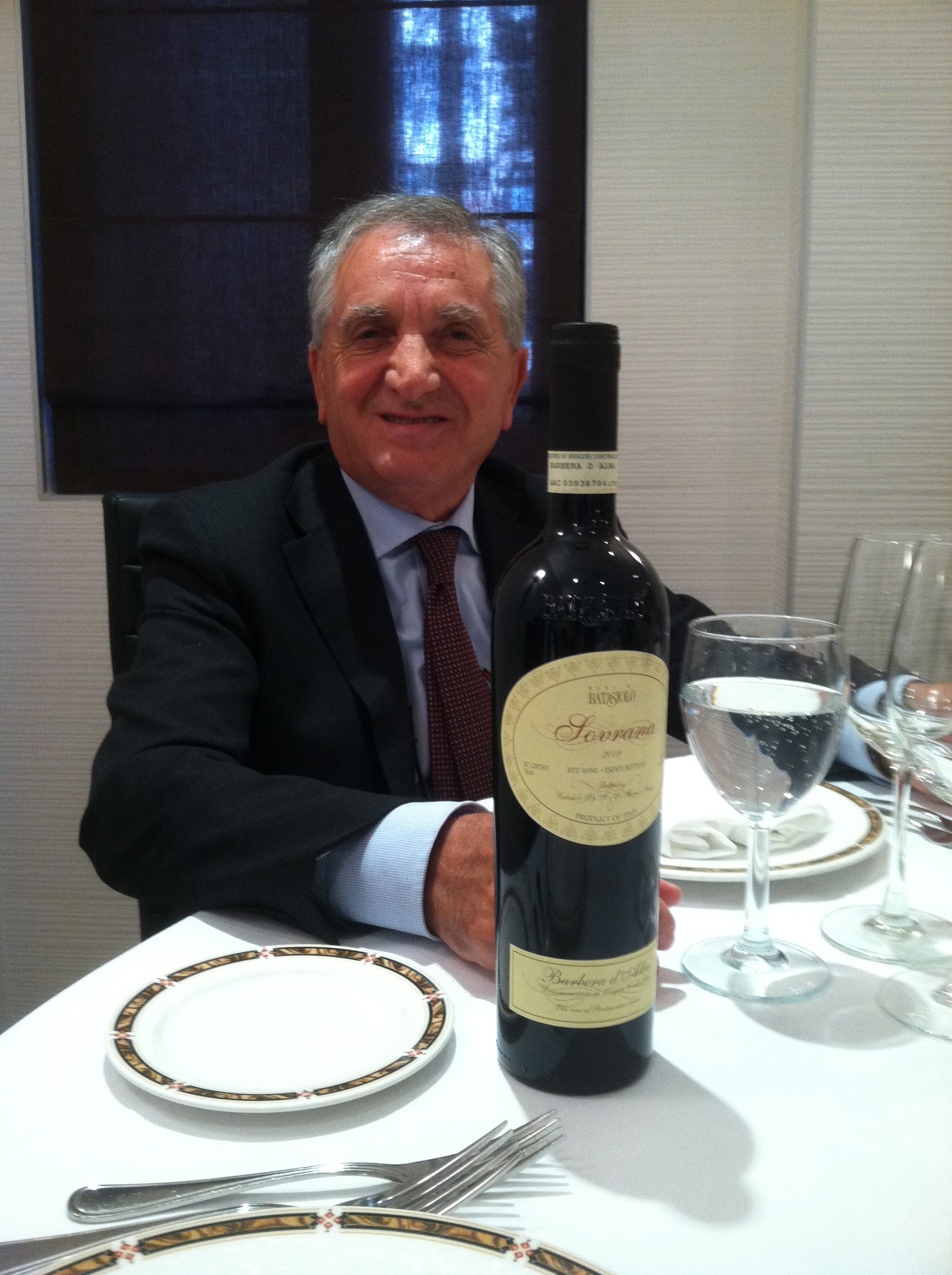
Fiorenzo Dogliani and the Wines of Beni di Batasiolo

When I was the wine director at I Trulli Restauant, we carried a number of Batasiolo wines. They were very well made wines and very well priced.  But I had not tasted these wines in a few years so when I received an invitation for a tasting and lunch at Il Postino, I was happy to accept.

Mr. Fiorenzo Dogliani

My host was Mr. Fiorenzo Dogliani, a charming and knowledgeable man, not only about wine but also about everything in the Langhe.  During the lunch we spoke about Piedmontese wine in general, the food of the area and the restaurants. I really enjoyed speaking to him.

He related a little of the history of the winery.  Dogliani was the original name but it had to be changed in 1978. This was done, Mr. Dogliani said, to avoid confusion with a large co-operative, which produced Dolcetto in the Dogliani designation. He said that there were seven beni farmhouses with vineyards- when they brought the property in La Morra in the 1950’s. The name Beni di Batasiolo was chosen because it was in keeping with the tradition that identifies a real value with the term “bene”, here applied to the land, the vineyards and the farm. The winery now has nine “beni” covering a total of over 100 hectares, 60 of which are planted with Nebbiolo.  Mr. Dogliani said that they have a philosophy of the land, understanding the terroir and using mostly traditional grapes and methods.

The Wine

Gavi del Comune di Gavi DOCG 2010 100% Cortese The vineyards are at 100/200 meters and there are 3,500 vines per hectare. They use the Guyot system modified into small arches. There is soft pressing with static decanting, and the alcoholic fermentation is under strict temperature control. The wine is bottled after malolactic fermentation. The wine has aromas of white flowers with hints of white peaches, citrus and good acidity. $18.9

Barbera D’Alba “Sovrana” DOC 2009 100% Barbera.  Mr Dogliani made the point that the vineyards are in Barolo and La Morra at 400/450 meters, facing south and southwest in the area that is usually reserved for Nebbiolo. It is calcareous soil rich in potassium and the vines are 55 years old. He feels this excellent position and the age of the vines along with the soil makes it a Barbera with unique qualities that can age.

The harvest takes place on Oct 2nd. Alcoholic fermentation with maceration on the skins is in stainless steel tanks for 10/12 days. In the spring the wine is transferred into oak barrels (second passage) where it matures for 12/15 months. After careful sampling the wine is assembled into the final product. The wine remains in bottle for 8/10 months before release.  This is a Barbera with good structure, tannin, fruit and acidity and it will age. $22.99

Barbaresco DOCG 2008 Made from 100% Nebbiolo. The area of production is the semi-circle of hills surrounding the three ancient villages of Barbaresco, Nieve and Treiso and part of San Rocco Seno d’Elvio, a tiny village overlooking the Tanaro River. Harvesting takes place from Oct 10 to 20.  Alcoholic fermentation takes place along with long maceration on the skins in stainless steel. The wine is aged for one year in traditional Slavonian oak barrels and one year in bottle. $36 

Barolo DOCG 2007 Made from 100% Nebbiolo, in its subvarities of Michet, Lampia and Rosé. Harvest takes place from the 10th of October to the first ten days of November. Traditional fermentation takes place in stainless steel with long maceration on the skins for 15/20 days.  Aging takes place in traditional Slavonion oak casks for 2 years and one year in bottle before release. The wine had flavors and aromas of dried fruit, spice and a touch of tobacco and leather. $40

Moscato D’Asti DOCG 2010 100% Moscato Bianco. The vines are grown in the hill terrain of Serralunga with a north, northwest exposure at 380- 410 meters. There are 3,500 vines per hectare and the vines are 15 years old. The soil is of calcareous and marl. Harvest takes place during the last 10 days of September. The grapes are hand picked and delivered to the winery in 20Kg containers, keeping the bunches intact as much as possible. There is a soft pressing of the grapes and a partial fermentation with abundant residual sugar. The juice is then cooled to zero C and stored in refrigerated vats. Fermentation begins a month before the first bottling, a very slow process reaching 5.5% alcohol by volume. It has aromas and flavors of pineapple; melon and a slight hint of oranges $16.99 

Moscato Spumante Rosè 2010 Made from Moscato Bianco and Moscato Rosa. Mr. Dogliani said that the Moscato Rosa came from the Trentino area. The grapes are harvested at the peak of ripeness.  After pressing the juice is then filtered in specially designed centrifuges. The liquid is stored in thermally insulated containers at extreme low temperatures. The secondary fermentation takes place in pressure tanks following the charmat method. This was a very easy wine to drink, with aromas and flavors of fresh red fruit $16.99 (the wine is not a Piemonte DOC because the Moscato Rosa came from Trentino.

Leave a comment

Filed under Asti, Barbaresco, Barbera, Barolo, Beni di Batasiolo, Gavi, Italian Sparkling Wine, Moscato d'Asti, Piedmont, Sparkling wine, White wine

Two Good Restaurant Wines and a 1970 Pinot Noir at Home

When I look at a restaurant wine list, I try to find wines that are a good value, have some age, and that will go with my meal.  Sometimes it seems like Mission Impossible.  But once in a while, I get lucky, as I did at Gigot, a small bistro in the West Village.

We started with

Beaumes-De-Venise 2004 Chateau Redotier.  The winery is owned by the Menthon family. The wine is 60% Grenache, 35% Syrah and 5% Counoise. The grapes are hand harvested. Fermentation is in temperature controlled stainless steel tanks and maceration lasts between 8 and 10 days. The wine is not filtered and is aged for two years in stainless steel tanks before it is bottled. This a wine with soft red fruit aromas and flavors, hints of raspberries, strawberries and nice fruity finish and aftertaste. It was perfect with the homemade country paté with toasted baguettes. Price at the restaurant $45

Coteaux Varois AOC 2004 “Clos des la Truffiere” Domaine Du Deffends.  This is also a family owned winery.  The wine is made from Syrah and Cabernet Sauvignon and the percentage depends on the vintage. Truffles are found in the vineyard and this is the reason for its name. It is their flagship wine. The soil is clay and limestone, the vineyard has a southeastern exposure and the vines are 25 years old. Maceration is between 12 to 18 days depending on the vintage. They punch down 2 to 3 times a day and a pneumatic press is used. It is aged 12 months in 25hl barrels and 1/2hogsheads vats (a hogshead is 63 U.S gallons) How long the wine is aged and what it is aged in depends upon the vintage. The wine is not fined or filtered. This is a rustic red wine with subtle fruit aromas and flavors with hints of blackcurrants and cassis, a mineral character and a long finish and nice aftertaste. This was a perfect combination with the cassoulet.  It is $45 on the wine list.

When friends come to my house for dinner and bring wine, I like to open their wine so that we can enjoy it together. The only times I do not do this is when I know the wine is from the dark side, or if it is too young. Recently a friend brought a California wine that was 42 years old. It was a Pinot Noir   from Inglenook, one of the oldest wineries in California, established by Gustave Niebaum in 1879. It reached its height after Prohibition under John Daniel Jr. a relative of Mr. Niebaum.  In fact from Prohibition to the 1960’s this winery may have produced the best wines in California. It has had a checkered history since then. However, over the last few years Francis Ford Coppola has been able to buy the old Inglenook vineyards and the winery.   He has changed the name of his winery from Niebaum-Coppola to Inglenook.

I was only too happy to open this wine.  Another guest brought a magnum of sparkling wine and I provided two Italian wines.

Pinot Noir 1970 limited Cask K-150, Estate bottled, Inglenook, Napa Valley. The wine was aged in small oak casks.  It is called Cask K-150 because occasionally in the cellar the wine maker discovers a cask of Pinot Noir that he feels is so special that he sets it aside for further aging. Later if it comes up to Inglenook’s highest expectations, it is marked “Cask”. This bottle was drawn from one of these special casks. The wine was only 12% alcohol.

This is still a big concentrated wine.  The oak and vanilla flavors are all still there.  The wine was showing some age but no way did it taste like a wine that was 42 years old. It did not taste like Pinot Noir at all.  It is always interesting to taste old California wines because they do not all taste the same but all of them up until the late 1970’s were 12% to 12.5 % alcohol.

At a Wine Media Guild event in the fall I tasted a Charles Krug 1966 and a 1974 Simi Cabernet Sauvignon. They were both  “lighter” in style, tasting like the grape with only a hint of oak. Even in California wines that are 40 years old or more, if they are too oaky to begin with, the oakiness does not go away.  

Cococciola Vino Spumante Brut NV 100% Cococciola,  Cantina Frentana. (Abruzzo)    This is an ancient indigenous grape variety of the province of Chieti. It is mainly grown in the area around Rocco San Giovanni. The big grape bunches are irregular in shape and some are wing-tipped. It is a grape with good acidity and good yields. In the past it was only used for blending with other grapes. The harvest takes place towards the end of September. The grapes are soft pressed and fermentation takes place in stainless steel tanks at controlled temperatures. Malolatic fermentation does not take place. Only the free run juice is used. This is an interesting sparkling wine made by the charmat method with citrus flavors and aromas and a hint of almonds.  

Vino Rosso Toscano de Tavola 1988 100% Sangiovese. Grato Grati I am glad that I have only one bottle of the 1988 left because it is starting to show its age. Time to begin drinking the 1990.

Ghemme “Collis Breclema DOCG 1996 100% Nebbiolo Antichi Vigneti di Cantalupo (Piedmont) A selection of the more mature grapes are made from the Breclema vineyard. The soil is rich in minerals and has good sun exposure and is 280 to 310 meters above sea level. Harvest takes place in late October. The grapes are destemmed and pressed and kept in oak casks for about two years.  It is typical Nebbiolo with hints of red berries, liquorice, violets and a touch of tar. The wine is at its peak right now.


7 Comments

Filed under Chianti Rufina, French Red, French Wine, Ghemme, Italian Red Wine, Italian Sparkling Wine, Sparkling wine, Spumante