Category Archives: Italian Red Wine

The Unique Red Grapes of Campania

The Campania region of Italy has some unique red grape varieties. The ancient Greeks originally brought many of these varieties while others that were thought lost during the phylloxera epidemic have been rediscovered. There is one that no one knows where it originated. These grapes make for very interesting wines

At a recent tasting of the Wine Media Guild held at Felidia Restaurant, we tasted some examples of the red wines of Campania:

Piedirosso: “The name… translates as “red foot” and the grape is also known as Palombina or Pre’e Palummo meaning respectively little dove and dove’s foot in dialect, the latter because of its red-colored triple-branched stem like a three-taloned bird’s foot,” according to Nicholas Belfage in his book Brunello to Zibibbo. Piedirosso is an ancient black skinned grape that does well in volcanic soil. It may be identical to the Colombina, the grape that Pliny the Elder (d. 79 AD) mentions in his Natural History. IMG_6185

Lacrima Christi del Vesuvio (tears of Christ) Rosso DOC 2013 Mastroberardino Piedirosso 100%. Volcanic loose soil very rich in minerals and the exposure is south – east. The vineyard is at 70 m above sea level and there are about 3,000 plants per hectare. The training system is radical back with guyot pruning and the average age of the vines is 15 years. Harvest takes place in mid-October. Classic red vinification is in steel tanks at a controlled temperature. The wine remains in the bottle for one month before release. The wine has hints of cherry, plum, cloves and a touch of smoke. $20IMG_6184

Piedrosso Campo Flegrei Riserva “Tenuta Camaldoli” DOC 2011 Cantine Astroni 100% Piedirosso The winery is located in Campi Flegrei west of Naples. The bunches were destemmed by hand to avoid any possible greenness in the wine. A small quantity of juice and skins was put into an open top tronconic cherrywood cask where it was fermented by indigenous yeast. The wine was treated as gently as possible, and only punching down was used for extraction. After the fermentation had finished, the wine remained for an extraordinarily long time on the skins, some 65 days in total, in order to extract all the tannins from the skins. The wine went through malolactic fermentation, which happened by itself, and was racked off in a small stainless steel tank where it stayed for a month.

Katell Pieven of Cantine Astroni

Katell Pieven of Cantine Astroni

The wine was bottled unfiltered. Only 1100 bottles produced.  This is the first Piedirosso riserva that I have tasted. This is a very elegant Piedrosso, well balanced and smooth with hints of black and red berries with a nice finish and long aftertaste.    The winery notes indicate that Piedirosso is “planted throughout Campania… the Piedirosso Beneventano and the Piedirosso Avellinese are completely separate varieties.” They do not specify which one is in the wine. $27IMG_6186

Falerno del Massico “Etichetta Bronzo DOC 2006   Masseria Felicia Made from 80% Aliganico and 20% Piedirosso. The winery is located at the foot of Mount Massico, Sessa Aurunca. The vineyards are at 200 meters and the soil is gray tuff, pumice and ash. The training system is guyot. Fermentation is in open conical chestnut barrels. Aging is in barriques for 12/14 months and 12 months in bottle before release. The wine has hints of cherry, plum and other red and black fruits with a touch of tobacco and oak. $50IMG_6194

Cassavecchia (old house) The origin of the cassvecchia vine is completely unknown. Legend has it that farmers found an old vine, which had survived phylloxera. It was rediscovered among ancient ruins in Pontelatone inside the remains of a walled garden near the via Latina, the ancient road which connected Capua with Alife. The vine that was found had a trunk 40 centimeters across and cuttings were taken from it and replanted.

Casavecchia “Centomoggia” 2010 Terre del Principe made from 100% Casavecchia. A “moggia” was a unit of measure for property in this area that historically had very small plots. In fact, a property measuring 100 moggia, or about 74 acres, was such a rarity that this place, located between Caiazzo and Castel Campagnano, was named Centomoggia, meaning one hundred moggia. The vineyards are located in Castel Campagnano, Pontelatone and Castel di Sasso, the exposure is northwest for the former and southeast for the latter two. Elevation is 985 ft. and the training system is guyot. Total acres of vines is 24. These are very old vines planted between 1912 and 1932 and the soil is clayey and skeletal. Harvesting is by hand and the grapes undergo a berry selection at the winery before a prolonged maceration and fermentation at a controlled temperature using native yeasts. Aging takes place in new 225liter French oak barrels for 12 months and one year in bottle before release. The wine has hints of blackberry, spice, liquorice and a touch of cloves $40IMG_6196

Pallagrello Nero: This grape variety is grown almost exclusively in Campania particularly in the province of Caserta. It was a favorite of Ferdinand lV the Bourbon King of Naples and Sicily. Pallagrello was believed to have been destroyed by phylloxera but was rediscovered in the 1990’s and has been replanted by a few wineries. It is not a color mutation of Pallagrello Bianco.

Terre del Volturbo IGT Vestini Campagnano made from 100% Pallagrello Nero. The winery is located in hills in the province of Caseta. The vines are at 250 meters. Classic vinification is in oak barrels. There is a short maceration period. The wine is aged for 18 months in new barriques and 3 months in bottle before release. The wine has aromas and flavors of black fruit with hints of plum, oak and vanilla. $50IMG_6197

 Montevetrano Colle di Salerno 2011 Montevetrano Silvia Imparato. The enologist is Ricardo Cotarella. The wine is made from 60% Cabernet Sauvignon, 30% Merlot and 10% Aglianico. The winery is located in the municipality of San Cipriano Picentino near Salerno. The vineyards are 100% meters above sea level. There are 12 acres of vines and the harvest is by hand from the end of September to the beginning of October. Fermentation is in stainless steel tanks for about 15 days and the wine is aged in new barriques for 10 to 12 months. This is a wine with hints of violet, blackberries, cherry, tobacco and chocolate. The wine did not have the strong aroma and flavors of vanilla and oak, which were present in past vintages. $60IMG_6195

Terre del Volurno IGT “Sappie di Sopara il Bosco” 2012 Nanni Copè, made from 90% Pallagrello Nero 5% Aglianico (clone VCR 23) and 5% Cassavecchia. The grapes are from a 2.5-hectare vineyard of the same name. The soil is mostly sandy with silt and clay. There are 1,750 vines per hectare and the vines are 30 years old. Organic farming methods are used but the winery is not certified organic. Only fully matured grapes are harvested by hand. The wine is fermented in stainless steel with natural yeast and the grape varieties are fermented together. Maceration lasts for 16/19 days and malolatic fermentation takes place in 500 liter barrels.The wine is aged 1/4 in new oak, 1/4 in second passage, 1/4 in third passage and 1/4 in bottles. The wine remains here for one year and then all the wine is aged in bottle for another for 8 months before release.

This is a wine with good fruit, hints of cherry and spice, good acidity and a long finish. The owner of the winery is Giovanni Ascine and his childhood nickname, Nanni Copè, gives the wine its name. $40

3 Comments

Filed under campania, Cantine Astroni, Cassavecchia, Italian Red Wine, Italian Wine, Masseria Felicia, Montevetrano, Nani Cope, Piedirosso, Vestini Campagnano

IL Marroneto: Traditional Brunello at its Best

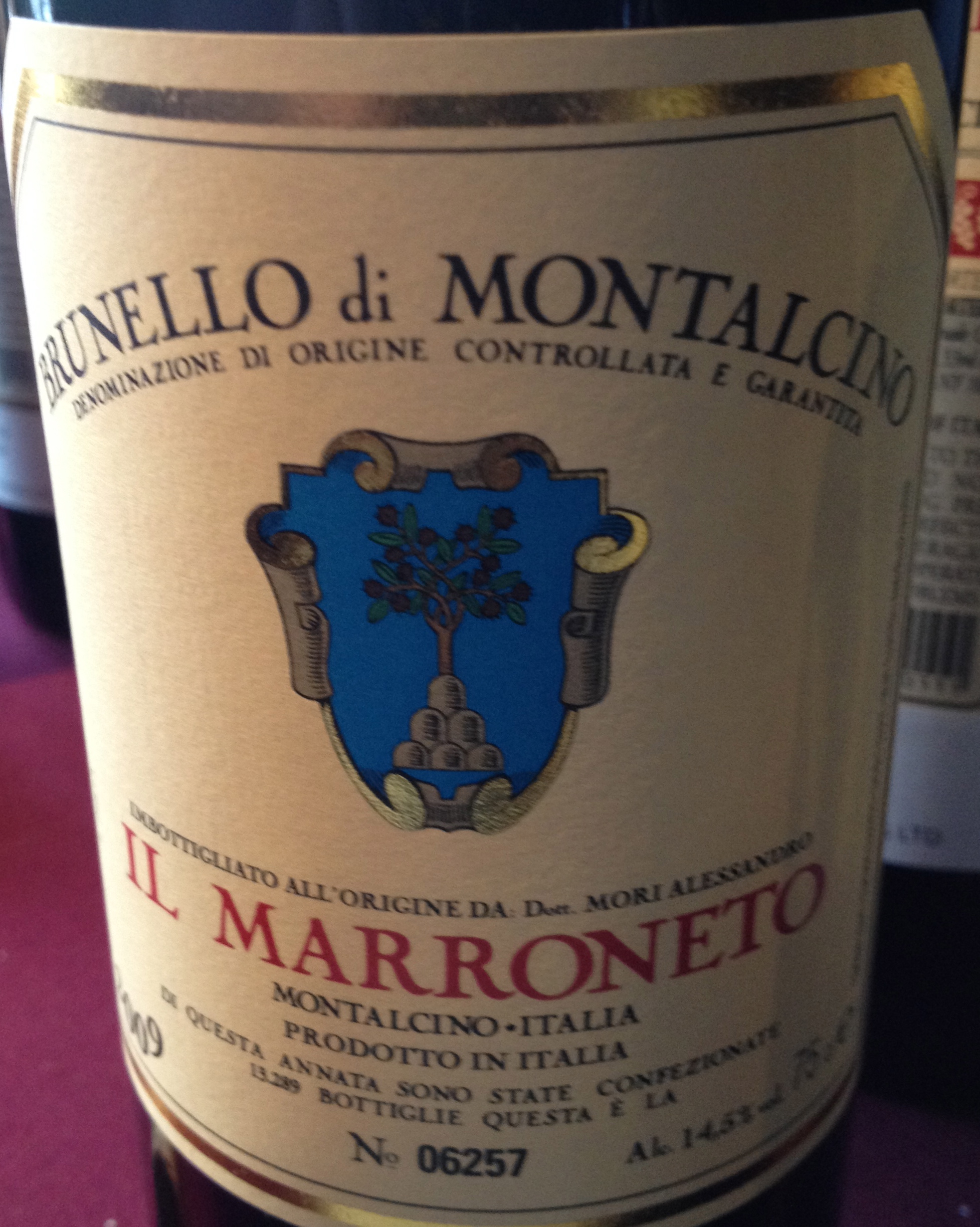
Often when I go to a wine tasting, people will recommend that I taste this or that wine and say, “it is your style.” At a recent tasting of the wines from Montcalm imports, everyone I met seemed to be telling me to taste the wines at table #13. A friend even went so far as to bring the winemaker/owner from table 13 to me to introduce him saying, “you must taste his wine.” Finally, I got to table 13. It was obvious that my friends know the kind of wines I like because it was one of my favorite producers of Brunello, IL Marroneto. At the table were the owner/winemaker, Alessandro Mori and his son Jacopo.

Jacopo and Alessandro

Jacopo and Alessandro

Alessandro told me that the wine really makes itself and he only does what is necessary. He has a traditional and minimalist philosophy both in the vineyard and in the cellar. IL Marroneto is one of the 10 historical wineries of Montalcino and was purchased in 1974 by Giuseppe Mori, Alessandro’s father.

The towers of the city of Siena are the backdrops of the estate’s vineyards located high on the north slope of the hill of Montalcino. The vineyards are at 400 meters and extend to the walls of the town. This is an area where grapes have been cultivated since the times of the Etruscans.

Alessandro said that they grow only Sangiovese grapes and follow a biodynamic approach to cultivation (although not certified), always abiding by the strict Montalcino regulations.  No herbicides are used on the plants.

The wines are aged in coveted Allier and Slovenian oak casks located in the 13th-century tower, which in past centuries was used for drying chestnuts. Learn more at www.ilmarroneto.it

The Wines of IL MarronetoIMG_6117

Rosso di Montalcino “Ignaccio” DOC  2010 100% Sangiovese. The vineyard is at 350 meters, the soil is coarse sand mixed with various minerals and the training system is spurred cordon. Fermentation takes place in stainless steel tanks with constant stirring for the first two days. Fermentation lasts for 20/22 days. The wine is aged in oak barrels for 8 months and another 6 months in the bottle before release. Alessandro said that this wine was a declassified Brunello but made in the same way and style. $30IMG_6116

Brunello di Momtalcino DOCG 100% Sangiovese. Fermentation lasts for 11/12 days. The wine is aged in 2,500 liter oak barrels for 39 months and 10 months in the bottle before release. $65IMG_6115

Brunello di Montalcino “Madonna della Grazie”  2009 DOCG 100% Sangiovese. This wine is made from a selection of grapes from the historical vineyards that surround the house. The name of the wine comes from the little 12th century church very near the vineyard, Madonna della Grazie. Fermentation is in Allier oak vats where it remains untouched for 2 days and the fermentation lasts for 20/22 days. The wine is aged in 2,500 liter oak barrels for 41 months and 10 months in bottle before release. $85

These are complex wines with aromas and flavors of citrus, cherry, licorice and mineral notes. They have a wonderful aftertaste and a long finish. They are excellent food wines and will age for a long time.

3 Comments

Filed under Brunello, IL Marroneto, Italian Red Wine, Italian Wine, Rosso di Montalcino

CELEBRATING MY BIRTHDAY

We spent my birthday weekend in the Hamptons at the home of our friends, Ernie and Louise De Salvo. Louise is an excellent cook and Ernie and I have the same taste in wine. IMG_5970

We started with lunch on Saturday with zucchini flowers stuffed with mozzarella and anchovies in a batter and deep-fried. This is one of my favorite foods and I have it whenever I am in Rome. With this we had a wine from a producer I did not know but it was a perfect combination with the flowers because it is a wine with a depth of flavor,hints of citrus fruit and good acidity.IMG_5956

Trebbiano d’Abruzzo “Fonte Canale” 2011 100% Trebbiano d’Abruzzo from old vines from Tiberio. The vineyard is at 300 meters, there are 2,500 vines /hectare and the training system is the tendone (vines form a canopy to protect the grapes from the sun). Harvest takes place the last week of September. Cold maceration on the skins lasts for 6 hours. Vinification takes place in stainless steel and malolactic fermentation does not occur. The wine remains in the bottle for a short period before release.IMG_5985

Champagne Premier Brut NV Louis Roederer is made from 40% Pinot Noir, 40% Chardonnay and 20% Meunier from 50 different crus. It is aged for 3 years in the cellar and 6 more months after dègorgement.IMG_5988

One of the dishes that Louise makes, which I love, is a cold melon soup with ginger. This was an interesting combination that worked well because the wine had nice fruity aromas and flavors and a hint of creaminess.IMG_5964

Barbera d’Alba 2001 Giacomo Conterno made from 100% Barbera d’Alba. The vineyard is in Serralunga d’Alba, the soil is calcareous limestone and the exposure is west/southwest. Vinification lasts for 2/3 weeks in wooden vats with regular breaking of the cap. The wine is then aged in large oak barrels for two years. Note–With the 2012 vintage, the Barbera with have Francia on the label as opposed to Cascina Francia, but the wine will remain the same.IMG_5963

When there are many different flavors in the foods Barbera is always a good choice because it is a red wine with good acidity. This one worked very well with the 3 cheeses, salumi, prosciutto, mortadella and best of all the flavorful roasted peppers made by Louise. The better Barberas can age for 20 years and this one was showing no signs of age.IMG_5969

Taurasi Riserva 1995 100% Aglianico Mastroberadino The soil is poor in organic substances but with a high content of clay, limestone, minerals and microelements. The vineyards are on two hills, Mirabella vineyard at 500 meters and the Montemarano vineyard at 550 meters. Because of its position on the hill and its altitude, the temperature at the Montemarano vineyard is much colder and the grapes are picked a little later. Harvest is from the end of October into the beginning of November. The vinification is the classic one for red wine, long maceration with skin contact at controlled temperatures. The wine spends one year in Slovenian oak barrels and two years in bottle, the wine can be laid down for 10 to 15 years. The riserva stays in medium sized 40 to 50HL oak casks for 2 years and 2 years in bottle. It can live in the bottle for 25-40 years. This is the way I believe the 1995 was produced. The wine was showing no signs of age. This is a full, complex wine with hints of black cherry, plum, spice, smoke and a touch of leather. IMG_5974

I was in the mood for Taurasi for my birthday. My favorite pasta is Pasta Matriciana and I had to have for my birthday along with the Taurasi.IMG_5978

Hermitage 1999 Domaine Jean-Louis Chave. It is made from 100% Syrah from 50 year old vines from some of the best plots in Hermitage with different soils. The wine is aged in 228 oak barrels for 18 months, 10 to 20% new and the rest 1 to 5 years old.IMG_5989

Ernie makes the best lamb on the grill. He takes pieces of lamb and thick slices of bacon and skewers them. A big wine like the Hermitage was perfect with its depth of flavor and hints of black and red fruit.IMG_5995

For dessert Louise made fig ice cream. I like it so much that the next morning for breakfast before we went home I had the fig ice cream Sicilian style — sandwiched on a warm brioche.


8 Comments

Filed under Barbera, Champagne, Chave, Hermitage, Italian Red Wine, Italian White Wine, Italian Wine, Louis Roederer Brut, Mastroberardino, Taurasi, Tiberio Winery

Venice, La Serenissima

IMG_5573

As we approached Venice by water taxi I was struck once again by how magical and dream-like this ancient city is with its picturesque canals, graceful bridges and beautiful architecture.IMG_5581

The taxi docked right beside a café and restaurant that looked as if it would be an ideal spot to have breakfast called the l’Ombra del Leone. When we returned the next morning, the place was empty although the outdoor seating was the perfect place to watch the gondolas participating in the celebration of the Festa e Regata della Sensa, an annual event. Among the boats was an ornate one called the Bucintoro used by the Doge, the leader of Venice. The mayor, replacing the Doge of old, throws a gold ring overboard to symbolize Venice’s marriage to the sea. Yes, Michele and I agreed as we sipped cappuccino and ate our cornetti, Venice is a magical city and full of surprises around every corner.

The Restaurants We Enjoyed

Zucchini Flowers

Zucchini Flowers

Ai Gondolieri is a meat lover’s restaurant in a city surrounded by water and known for its seafood. The restaurant began as an old inn where locals could go to eat simple meats, drink a glass of wine and play cards. Today it has become a refined, quiet restaurant with excellent service and food. I had perfectly fried zucchini flowers to begin and then slices of calf’s liver on Venetian polenta, which was wonderful.

Calf's Liver

Calf’s Liver

With dinner we had a wine that I have been drinking for many years, the Villa Capezzana Carmignano 2008 DOCG made from 70% Sangiovese, 20% Cabernet Sauvignon and 10% Canaiolo.

IMG_5575 The hillside vineyards are at 150 to 200 meters and the exposure is south, southeast and southwest. The soil composition is shale and the harvest is in mid September. Vinification is in steel tanks and the wine is aged in 25HL Allier barrels for 10 months. It remains in bottle another 3 months before release.

Pensione, Restaurant Wildner  I posted pictures of Venice on Facebook while we were there and a friend, Faith Willinger, who lives in Florence and is a noted cookbook and travel writer saw them. She wrote that I should go to this “fantastic restaurant” and that “the wine list will blow you away.” She added that we should ask for Luca Fullin, the son of the owner who is responsible for the wine list. With a recommendation like this we just had to go. The restaurant is right on the Grand Canal and there is out door dining.

Pasta with Zucchini and Zucchini Flowers

Pasta with Zucchini and Zucchini Flwers

We introduced ourselves to Luca and told him that Faith highly recommended the restaurant to us.

Seppei

Seppei

We discussed the extensive wine list and I found a wine I had never had before from one of my favorite producers, the Cerasuolo di Abruzzo Rosato which is a Rose from Emidio Pepe 2012 vintage made from 100% Montepulciano d’Abruzzo . The grapes are vinified as if it was a “white wine” and are pressed by “foot” and the must is fermented without the skins. It was one of the best Rose wines that it has ever been my pleasure to drink.IMG_5597

The wine was an excellent combination with pasta with zucchini and zucchini flowers to start followed by seppie (cuttlefish) in a black ink sauce and peas with grilled polenta.

Fiaschetteria Toscana This restaurant began as a Tuscan wine shop where products from Tuscany were sold. It later became a trattoria and in 1983 a restaurant. Michele and I have been coming here for a number of years.

Moleche

Moleche

It has a very nice dining room and two upstairs rooms for larger parties and outdoor dining in a small piazza just across the street. I ordered the moleche, which are baby soft shell crabs. They were crisp and full of flavor and I order them whenever I can. We ended with Michele’s favorite, wild strawberries with crema gelato.

5 Comments

Filed under Ai Gondolieri, Capezzana, Cerasuolo, Emidio Pepe, Fiaschetteria Toscana, Italian Red Wine, Italian Wine, Restaurant Wildner, Rose, Uncategorized, Venice

Eating and Drinking around Lake Garda

Lake Garda in Northern Italy is a favorite place to visit. Usually we stay on the western side but on a recent trip, Michele and I decided to stay in Bardolino, which is on the eastern side.

Sunset on Lake Garda

Sunset on Lake Garda

Bardolino is a very picturesque town right on the lake. We stayed in a hotel about a kilometer from the center and it was a lovely walk along the lake into town. There are many excellent restaurants in the area.IMG_5453

Enoteca con Cucina Il Giardino delle Esperidi This restaurant in the heart of Bardolino is a true gem. A friend and fellow wine writer, Tom Hyland, recommended it. There are about 700 labels on the wine list, both Italian and foreign, and a large selection of Champagne. The prices are very good.IMG_5446

When we arrived, Susanna Tezzon, who runs the front of the house and is in charge of the wines, greeted us. After speaking with Susanna, I ordered a bottle of Emidio Pepe 2003 Montepulciano d’Abruzzo. 100% Montepulciano d’Abuzzo. The Emidio Pepe winery is both organic and biodynamic. The winery belongs to the Triple “A”– Agriculturists Artisans Artists, an association of wine producers from around the world that believes in Organic and Bio-Dynamic production, terroir, and as little interference as possible by the winemaker in the winemaking process. In their vineyard only sulphur and copper water are used along with biodynamic preparations. Only natural yeast is used which gives the wine more complexity because there are so many different strains of yeast on the grapes and in the air. The grapes are crushed by hand. No sulfites are added to the wine. The juice is placed in glass lined cement tanks of 20/25hl. The wine remains here for two years. The wine is then transferred to bottles by hand.IMG_5449

Susanna brought out a decanter and said it was a one made especially for organic wines. I had never heard of this before but the restaurant was busy and we were enjoying the food and wine so much that I did not ask any more about it.

Salami and Cultello

Salami and Culatello

The food could not have been better and we had a number of courses including Guinea Hen, Salami and Culatello

Locanda Sul Minico

Locanda Sul Minico

Antica Locanda sul Mincio in Borghetto Valeggio sul Mincio. This restaurant may be Michele’s favorite as far as location is concerned. The outdoor dining area is on the riverbank of the Mincio River and it overlooks the medieval village. The view is incomparable. The restaurant has more than just a picturesque setting, however, the food is also excellent.

Grilled Polenta with Fresh Salame

Grilled Polenta with Fresh Salame

Among the dishes we had were grilled polenta with fresh salame, ravioli filled with pear and ricotta and for a main course, roasted goat. IMG_5516

With our meal we drank a bottle of Valpolicella Superiore from Azienda Agricola Marion DOC. 10% Corvina Gentile, 60% Corvina Grossa, 20% Rondinella, 10% Teroldego and other varieties.The winery is in the foothills of the Marcellise Valley some 100 meters above sea level. The vineyards lie on gently sloping hills facing from north to south. The soil is chalk with a little clay and stones. The grapes are harvested between the first and second weeks of September and the first week of October. Part of the grapes are collected in boxes and then placed on wooden racks in well-ventilated rooms, where they are partially dried for approximately 40 days. A second part is left hanging on the vines until it reaches super-ripeness, to be harvested during the first ten days of October, and then pressed. After fermentation the wines obtained are aged separately in small oak barrels for about 30 months and lastly blended and bottled.   This is a wine with a lot of body and aromas and flavors of prunes and blackberries.

Taverna Kus di Zanolli Giancarlo This restaurant is in San Zeno di Montagna and there is a great view of Lake Garda below and Monte Baldo above. There is a garden dining area, a covered outdoor area, and an inside area.IMG_5475

We drank a 2006 Amarone della Valpolicella from one of the best producers of Soave Pieprone. In 1999 the Pieropan family purchased property in the Cellore d’Illasi zone in the Valpolicella and Amarone production zones. The wine is made from 60% Corvina, 30% Corvinone, Rondinella and Croatina, and 10% of old traditional Valpolicella varieties. The vineyard is 14 years old and is South facing at an altitude of 500 meters. There are 5,800 vines per hectare, the training system is guyot, pruned to 8 buds per vine. The grapes are hand picked in September and naturally dried. They are pressed and destemmed and the must is fermented for about 30 days during which time pumping over and punching down the cap takes place every day. Aging is in 500 liter barrels for 24/30 months and one year in bottle before release. This is an Amarone to drink with food. It has hints of blackberries, black cherries and plums. This is the first tine I have had this wine and I was very impressed by it.IMG_5479

We began our meal with plates of culatello accompanied by carrot mostarda, followed by a dish of artichokes baked with cheese, an unusual dish that we really enjoyed.

Ristorante Alla Borsa- this is a restaurant in center of the town of Valleggio sul Mincio. It used to be a trattoria where the merchants of the village met to conduct business. Because of this it was called Borsa, which means purse or stock exchange in Italian. The restaurant has a very nice outdoor garden where one can dine and view the old Scaligero castle.IMG_5459

We drank a Valpolicella Classico Superiore IGT 2010 “La Fabriseria” from Tedeschi. 35% Corvina, 30% Corvinone, 30% Rondinella and 5% Oseleta. The wine is made from grapes that are used for their amarone but are fermented without drying. The grapes are harvested in October and are slightly overripe. The pressing is very soft so that some of the grapes remain whole with the stem. The must ferments in small fermenting vats. Alcoholic fermentation lasts for about ten days. Skin contact is for about 20 days and malolactic fermentation is quickly terminated in Slovenian oak barrels. The wine is aged one year in wood and six months in bottle before release. The wine had hints of prunes and cherries and a hint of vanilla.

Tortellini with Butternut Squash

Tortellini with Butternut Squash

The town of Valeggio sul Mincio and the Restaurant Alla Borsa are renowned for their excellent tortellini, so we had three varieties: cheese, butternut squash and meat filled.


2 Comments

Filed under Antico Locanda sul Minico, Emidio Pepe, IL Giardino delle Esperidi, Italian Red Wine, Italian Restaurants, Lake Garda, Marion Valpolicella, Pieropan Amarone, Ristorante alla Borsa, Taverna Kus, Tedeschi

Wine Dinner at the Westchester Italian Cultural Center

IMG_5842

Louis Coluccio at Work

One of the things I enjoy most about the Italian wine dinners I host at The Westchester Italian Cultural Center in Tuckahoe, NY is the opportunity to work with my friend Louis Coluccio, the proprietor of A.L.C. Italian Grocery in Bay Ridge, Brooklyn. Louis prepares the delicious food and I match it with the right wine. For our most recent event, we discussed the food and I selected some of my favorite wines from Campania.

The WinesIMG_5834

Monte di Grazia Bianco IGT 2012, made from the following local grapes: Pepella has only a few large grapes on the bunch, the rest being the size of peppercorns, though they all ripen at the same time. Ginestra, the name comes from the yellow-green color, which is similar in color to the gorse flower. Bianca Tenera (Biancolella) a local white grape. The wine has hints of citrus with undertones of pear and almond, a very nice mineral character and good acidity. It is fermented and aged in stainless steel tanks. $20  This was served with a Raw Kale Salad with Roasted Vegetables.IMG_5835

DonnaChiara Greco di Tufo 2012 DOCG, 100% Greco di Tufo. The soil is tuffaceious and the training system is espallier. There are 3,300 plants per hectare and the harvest takes place during the second week of October. The grapes are not destemmed or crushed prior to pressing and there is cold fermentation with extended maceration. No oak is used. This is a wine that needs at least 5 or 6 years of bottle age before it is ready to drink. It has nice citrus aromas and flavors, a hint of smoke and a touch of almonds in the finish and aftertaste. $18  With this we had Crostini with Eggplant Caponata.IMG_5838

 Cantina Federiciane Montelone di Napoli Gragnano DOC Sorrento Peninsula 2013, made from Piedirosso and Sciascinoso. Fermentation with selected yeast takes place in temperature controlled autoclaves.  This is a fizzy red wine that when poured has a lot of foam that quickly disappears in the glass. It is fruity with red fruit aromas and flavors, hints of raspberries and strawberries, and easy to drink. In Naples they often drink sparkling beverages with pizza and Gragnano goes very well with pizza margarita. Sciascinoso, also know as Olivella, is used as a blending grape. The clusters and berries are large and it is a late ripener. I do not believe that I have ever tasted a wine made from 100% Sciascinoso. $16IMG_5839

This was served with Assorted Imported Salami & Fresh Figs.IMG_5837

Az. Agr. Apicella Colli di Salerno Piedirosso IGT 2012, made from 85% Piedirosso from ungrafted vines and 15% other red grapes. There are 3,000 vines per hectare and the training system is mostly pergola. Harvest takes place the third week of October. The stalks are removed and the grapes are pressed. Temperature controlled fermentation in stainless steel tanks for 10 to 12 days. Piedirosso is used mostly as a blending grape. It is difficult to find wine made from 100% Piedirosso but worth the effort. The wine has fresh red fruit flavors and aromas with hints of black pepper and spice, a long finish and nice aftertaste. The wine should be drunk young. It goes extremely well with dishes made with tomato sauce. It is a steal at $16.IMG_5840

This was served with the Pasta with Pesto Arugula and Cherry Tomatoes.IMG_5836

Az. Agr. Monte de Grazie Biological Winery Rosso 2008 The wine is made from 90% Tintore di Tramonti from very old ungrafted vines and 10% Piedirosso. The Tintore di Tramonti grown almost exclusively in the Monte Lattari Valley. The grape is harvested at the end of September, which makes it an early ripener for this area. This indigenous red grape variety belongs to the Teinturier family. Teinturier means dyed or stained in French. The flesh and the juice of these grapes are red in color. The anthocyanin pigments accumulate in the grape berry itself. The free run juice is therefore red. This is a complex wine with earthly aromas, red fruit and a slight hint of black pepper and spice with good acidity that makes it a very good food wine. This wine has aging potential. $30. We ended with an Assorted Cheese Board which included ricotta salata, aged provolone, and other Italian cheeses.


3 Comments

Filed under A.L.C. Italian Grocery, Gragnano, Greco di Tufo, Italian Red Wine, Italian Wine, Louis Coluccio, Monte de Grazia Winery, Monte de Grazie Winery, Piedirosso, Tintore di Tramonti, Westchester Italian Cultural Center

New Discoveries

10322755_741319212585624_110029537206769143_n

Speaking about the wine

Riccardo Gabriele introduced me to a group of Italian wines that he represents and asked me to speak about them to a group of wine writers.   The Trattoria dell’Arte was the perfect spot for the luncheon and tasting. Some highlights were a wine made from pre-phylloxera grapes and another made from Tempranillo grapes – both from Tuscany!

It was an exciting opportunity for me to taste and discuss these wines with other wine writers. IMG_5362

Manicardi “Vigna Ca del Fiore” DOC 2013 Lambrusco Grasparossa Castelvetro 100% Grasparossa. There are 2,600 plants per hectare and the training is cordon spurred. Fermentation and maceration is in temperature controlled stainless steel tanks. Second fermentation is by the Charmat method–cold maceration is in pressurized temperature controlled tanks and grapes must be stored under pressure and at 0ºC. This is a dry Lambrusco fruity and low in tannin, high in acidity which goes very well with the rich food of the Emilia region, such as cotechino, zampone, bolito misto, Parmigiano-Reggiano and prosciutto di Parma.

In a restaurant outside of Parma I discovered a very simple but excellent end to a meal: a perfect ripe pear, walnuts, a wedge a Parmigiano-Reggiano and a glass of dry Lambrusco. I have been a fan of dry Lambrusco ever since.

Lambrusco is a family of kindred grapes. The three best quality sub-varieties include Grasparossa (red stem), the darkest in color and the most robust.   It comes from the village of Castelvetro, south of Modena, and is the one that I prefer. Sorbara, the most delicate, and pricy comes from the village of the same name. Salamino, meaning little salami, is so called because of the sausage-shaped bunches, comes from the area around the village of Santa Croce. The wine is not imported in to U.S.IMG_5363

Il Marroneto Brunello di Montalcino DOCG “Madonna della Grazie” 2008 named for the church close by the winery. This producer only grows Sangiovese grapes. The winery is just northern of the town of Montalcino. The vineyard is at 400 meters with a northern exposure. Soil is sandy and rich in minerals. The training is spurred cordon. They use biodynamic methods but are not certified. The wine rests on the skins completely still in Allier oak vats for the first two days as the temperature slowly rises naturally to 30 degrees after 5 days. Fermentation takes between 20 and 22 days. The wine remains in oak barrels of 26HL for 41 months (Slovenian and Allier) and is released after 5 years, including 10 months in bottle. This is a traditional Brunello and will last for many years. 2008 was an excellent vintage. $55IMG_5364

Pagani de Marchi “Principe Guerriero” 2009 Montesuadaio DOC 100% Sangiovese. Casale Marittimo, Pisa. The vineyard is 3 hectares and it is 200 meters above sea level. Soil is sedimentary clay, calcareous, and rich in potassium. The training is guyot, age of vines is 15 years and there are 2.2 hectares of Sangiovese. Exposure is south, southeast and southwest. Vinification is in 50Hl stainless steel tanks, traditional pumping over andmalolactic fermentation is in oak barrels. Natural yeast. No chemical weed control. Aging is for 12 months in oak barrels 30% new, 12 months in bottle before release. A small Etruscan necropolis on the property and an Etruscan warrior’s tomb gives the wine its name. $35IMG_5365

Colle S. Mustiola “Poggio ai Chiari” 2006 IGT Tuscany. Made from 100% Sangiovese from a four hectare vineyard near Lake Chiusi in Tuscany. The exposure is northeast and the vineyard is at 300 meters. Flood soil with pilocene sand. There are 10,000 vines per hectare. The harvest takes place the second week of October.       Maceration lasts for 40 days with submerged cap fermentation. There is spontaneous malolatic fermentation. The wine spends 36 months in barriques and a small part in Slovenian oak barrels of 20hl, followed by 24 months refinement in bottle before release.

The winery made a selection of 28 different clones of Sagiovese of which five were pre-phylloxera – not grafted on to American rootstock. There is now one vineyard with 10,000 per phylloxera vines. $40  IMG_5366

Podere Boscarelli Vino Noble di Montpulciano Riserva 2009 DOCG. Usually 86% Prugnolo Gentile, 10% Merlot and 4% Colorino. Rolling hills at 300 meters going down to the river Chiana. Soil is silt and clay. The vines are 6 to 35 years old and are selected from clones from their own vineyards. There are 6,000 plants per hectare, selection at harvest by hand into small crates 2/3 of capacity and another selection in the cellar. Fermentation is with the stalks and after a soft pressing the grapes ferment in little vats of steel and oak–only to 3/4 of capacity. Fermentation lasts for one week at 28/30º C. Maceration for 5 to 8 days. Only natural yeasts are used. Aging is in 350/2,000 liter barrels of Slovenian oak or French Allier. A little filtration is carried out before bottling if necessary. $45IMG_5367

Podere La Chiesa “Sabiniano di Casanova” 2008 IGT Tuscany 60% Sangiovese, 25% Cabernet Sauvignon and 15% Merlot.

The vineyards are located in Podere la Chiesa in Cassanova.       The vineyards face southeast and southwest growing on a clay soil rich in fossil shells, typical of the area.

Each grape variety is vinified separately. There are 2 to 3 pumpovers a day which protects the cap from oxidation. The training is cordon spur and there are 4,500 per hectare, which are hand harvested. Natural yeast is used and temperature controlled fermentation takes place in stainless steel. Maceration is for 12/15 days, 12 months in French barriques and 18 months in the bottle before release. Not imported.IMG_5368

Beconcini “IXE” is the Tuscan pronunciation for the letter X. The letter X stands for unknown vines which turned out to be Tempranillo. The IGT is Tuscany Tempranillo. This wine is made from 99.9% of Tempranillo and a touch of Sangiovese. The winery is located in the town of San Miniato. The vineyard is 3.5 hectares and the grapes are all from the new vineyards planted in 1997 using a massal selection from buds taken from the century old vines of Tempranillo from the Vigna alle Nicchie. The training is spurred cordon. Soil is sandstone with marine fossil formation, well integrated with abundant clay. 100/150 meters above sea level and there are 7,000 vines per hectare. Harvest the first 10 days of September. The grapes are dried for 4 weeks and they obtain a total yield of 70%. Fermentation takes place in temperature controlled glass lined cement vats, maceration is for 3 weeks. Aging lasts for 14 months in 70% French barriques and 30% American oak barriques of second passage. 6 months in bottle before release. First passage in barriques is for the wine from the grapes of the historical vineyard Vigna alle Nicchie that goes into the wine of the same name.

In the early 1950’s, 213 vines of unknown species were found in the vineyard which were called X vines. With help from the Ministry of Agriculture these vines were declared to be Tempranillo a few years ago. In June of 2009, Tempranillo N nero was enrolled in the Tuscan register. As far as I know Tempranillo was never cultivated before in Italy.

The Via Franchigena was an old Roman road which was used by pilgrims in the 17th century to make the pilgrimage to and from Santiago de Compostela (Rioja) in Spain to Rome. This road passed close to the town of San Miniato near where the winery is now located. Spanish pilgrims may have carried the Tempranillo seeds and actually sewed them in the vicinity of San Miniato as was the custom of the time. Scientists have determined that the vines were from seeds, not cuttings. Legend has it that a local priest tended the vines not knowing their origin. Not imported.


Leave a comment

Filed under Brunello, Italian Red Wine, Italian Wine, IXE, Uncategorized, Vino Nobile di Montepulicano

Pizza Week

Two weeks ago, everyone I knew seemed to want to go with me for pizza. I was ready to go, but instead of the Neapolitan style I normally prefer, I decided to vary the style a little and try some different types of pizza.

The first pizza that week was with a wine group that I belong to called the G6. It really should be called the P6, P for pizza, because we always wind up having pizza. As usual we went to La Pizza Fresca, 31 East 20th Street in NYC for pizza and, of course, wine.IMG_5151

I like champagne with pizza and we had Champagne William Deutz Brut 1995. Made from 75% Pinot Noir and 25% Chardonnay from grapes of Grand Cru vineyards.

IMG_4540

Monte Bianco

The Monte Bianco pizza at La Pizza Fresca has become one of my favorites. It is topped with Robiola, Parmigiano Reggiano, Fontina, porcini mushrooms and Prosciutto di Parma. It was an excellent combination with the Champagne.

IMG_4785

Sorrentina

A wine writer friend, Tom Hyland, was in from Chicago and he wanted to go to Kesté Pizza and Vino, 271 Bleecker St. Another wine writer, Tom Maresca, joined us and he brought a bottle of a white wine from Campania that I had never had before. For a starter, we had the battilocchio (meaning blink, because of the shape) del giorno. Two of my favorite pies at Kesté are the Margarita made with tomato sauce, homemade mozzarella, pecorino romano, basil, and extra virgin olive, and the Sorrentina, topped with imported smoked buffalo mozzarella, sliced lemon and basil. IMG_5239

The wine was the Grecomuso Campania 2012 IGT Ag Az Contrade dei Taurasi Made from 100%  Rovello Bianco. The soil is patchy with a prevalence of loose soil, rich in volcanic cinerite ( mostly volcanic ash ) and/or limestone. The vines are mostly grafted and the vineyard is at 300 to 500 meters. Training is guyot and pergola Avellinese. There is a manual harvest and the grapes are destemmed. Fermentation with maceration takes place at room temperature. The wine is aged in stainless steel tanks for 6 to 8 months. After several decanting to clarify the wine it is bottled after a coarse filtration through porous inert cartridges of 3 microns. This is a tangy wine with good fruit aromas and flavors, nice minerality and a hint of peaches.

IMG_5246

Pizza Pala

Friends wanted to try one of my favorite pizzerias, Ribalta, at 48 East 12thSt. They make several styles of pizza. One of their specialties is the “Pizza Pala.” Pala is a baking method in which the dough is baked twice creating a unique crisp outside and soft inside. It is served in a square pan and though the menu says it is for two, it is really enough for four. We had the Pala Norma, topped with fried eggplant, cherry tomatoes and mozzarella.IMG_5241

With it we drank Aglianico del Vulture DOC 2009 “Likos” Vigna Mastrodomenico (Basilicata) 100%, Aglianico del Vulture. The wine is aged in regenerated French oak barrels with a custom toasting, and in stainless steel tanks for 8 to 10 months and 6 months in barrel before release. This is a big wine with berry aromas and flavors, hints of cherry and plum and a long finish and nice aftertaste. It is a wine that can age.

Another friend, wine writer, blogger (www.Do Bianchi.com) and Renaissance man Jeremy Parzen from Houston was in town with a wine producer, Paolo Cantele from the Cantele winery in Puglia and they wanted Pizza, so we went to Pizzetteria Brunetti, 226 Hudson St.

IMG_4873

Margarita

We had pizza with vongole, fresh shucked and chopped Long Island clams in a garlic and herb butter sauce and a touch of basil and a Margarita made with San Marzano DOC tomatoes, house made fior de latte mozzarella, basil, sea salt and extra virgin olive oil.IMG_5259

The wine was Champagne Pol Roger Rose 1995.Pol Roger Rosè vintage is based on their brut vintage which is 60% Pinot Noir and 40% Chardonnay to which they add before the bottling and second fermentation about 15% still Pinot Noir from the best crus of “montagne de Reims”. The wine is aged in the cellar before release. Champagne Ed Mc Carthy and Mary Ewing-Mulligan, MW provided the Champagne.

5 Comments

Filed under Champagne, Italian Red Wine, Pol Roger

Pairing Gnocchi with Three Wines from The Alto Adige

Gnocchi ricotta with tomato-butter sauce

A few weeks ago Michele made ricotta gnocchi with tomato-butter sauce from her new book “The Italian Vegetable Cookbook” for a dinner with friends. One of the guests said that she had tried making potato gnocchi but they never turned out right. Michele said that ricotta gnocchi were very easy to make and she would be happy to show her. Last Saturday, our friends returned and brought prosciutto and melon for an antipasto and three bottles of wine from the Alto Adige to see which one matched best with the gnocchi.IMG_5206

Michele and I used to do wine and food pairing classes and we found that one of the following scenarios was typical:

-The wine and the food may be good on their own but in combination they do not work and leave a bad taste in your mouth.

-The next is when the wine and food do not combine but each keeps its own individual character.

-The last is when the wine and food combine to give you the perfect combination.IMG_5204

Südtirol Eisacktaler Kerner 100% Kerner. Abbazia Di Novacella. The vineyards are 600-700meters, the soil is gravelly morainal deposits and the exposure is south-southwest. The training system is guyot, there are 6,000 to 7,000 vines per hectare and the harvest takes place in October. Fermentation takes place in stainless steel tanks at 20°C. Only natural yeast is used and the wine remains in stainless steel tanks for 6 months before it is bottled. This is an aromatic wine with hints of apple and peach, ripe and full with crisp acidity.

We drank this wine with the prosciutto and melon, and it was a perfect combination. Later, we tried the Kerner with the gnocchi. It was good, but the flavors did not marry. The tastes remained separate.IMG_5205

Alto Adige Sauvignon Sanct Valentin 2012 100% Sauvignon Blanc St. Michael-Eppan. The grapes come from different vineyards in Appiano Monte all at 400 to 600 meters and the vines are 10 to 18 years old. There is long maceration at low temperatures in steel tanks and then 12% of the wine is aged and refined in big and small oak casks. This is sauvignon blanc from Italy with all the characteristics of the best is sauvignon blanc with a hint of figs and light spice. This is one of Michele’s favorite producers of white wine and I have to agree with her.

The Sauvignon blanc overwhelmed the gnocchi so that there were two different tastes but mostly Sauvignon blancIMG_5202

Hexenbichler Schiava Alto Adige DOC 2012 100% Schiava Tramin The grapes come from the 6 acre Hexenbichler vineyard. The soil is clay-loam and pebbles, the training system is Pergola, the elevation is 990 to 1,320 feet and there is an eastern exposure. Harvest takes place in September. Fermentation is in stainless steel tanks for 10 days and aging takes place for 6 months in 50 to 100 HL steel tank. Length of time before bottling is 6 months and 2 months in bottle before release.IMG_5209

This is a light red wine with fresh fruit flavors and a nice finish finish and aftertaste. It was the perfect combination with the gnocchi, the light fruitiness of the blended perfectly with the delicate ricotta gnocchi and the tomato and butter sauce.


3 Comments

Filed under Abbazia di Rosazzo, Alto Adige, Italian Red Wine, Italian White Wine, Italian Wine, Kerner, Sanct Valentin, Sauvignon Blanc, Schiava, St. Michele-Eppan, Tramin winery

Gnocchi and Boca

Company was coming and Michele wanted to make something from her new cookbook: The Italian Vegetable Cookbook: 200 Favorite Recipes for Antipasti, Soups, Pasta, Main Dishes and Dessert. She asked me what I was in the mood for but with so many delicious choices, I could not make up my mind. Then I saw the picture of the Basil Ricotta Gnocchi in Tomato Butter Sauce and I knew that was it. I planned to match it with the 1985 Boca.IMG_5102

We started the evening as we usually do with Champagne:IMG_5095

Champagne Delamotte Brut NV 50% Pinot Noir, 30% Pinot Nero and 20% Pinot Meunier. Light and fresh with citrus aromas and flavors and good acidity. The sister house is Salon and both are part of the Laurent-Perrier group. At $38 a bottle, it is a bargain and is our current house champagne.

Boca 1985 Campo Delle Piane La Meridiana made from 85% Nebbiolo,15% Vespolina and some bunches of Bonarda.  Boca is Piemonte’seasternmost DOC zone, and with theexception of the also little known area of Sizzano, it’s northernmost as well. It is entirely surrounded by a mountainous national park. It forms something of a southerly exposed amphitheatre at 400-500 m elevation, just west of Lago d’Orta.IMG_5099

For over 60 years, Antonio Cerri, the owner of La Meridiana, made Boca from his one half hectare of vines. He seemed more concerned with making Boca than with bottling and selling it.  Enter Cristoph Kunzil, a Swiss importer of Italian wines. Antonio was ready to retire and Mr. Kunzil saw an opportunity so he bought the land and the cellars. He spent time with Antonio to learn the history of the place and the wines. The La Meridiana winery does not exist any more and Mr. Kunzil calls his winery Le Piane.

Gary Olson of Artisan Wines Inc., the importer and distributor, put me in touch with Mr. Kunzil who told me that the current wines under his Le Piane label are made the same way as the wines of Anthonio Cerri, and added that the cellar may be a little cleaner.  Long fermentation occurs for about a month and no yeast is added. The aging is in barrels of 20hl for 5 years or more for the  wines that were made by Mr. Cerri and 3-4 years for the Le Piane.  Le Piane owns the Cerri wines, and sells them as a rarity to show the potential of the Boca region.

Mr. Kunzil said that the1985 was the best of the bottled wines of Mr. Cerri, still young and with a lot to give. The 1985 was bottled in 1995. The wines from this area are lighter than the ones from around Alba and therefore were a perfect combination with the ricotta gnocchi and light tomato sauce. I was very impressed with the wine. IMG_5096

Barbaresco 1998 DOCG La Spinona. I00% Nebbiolo. The winery is located in the town of Barbaresco and it is a family run winery operated by Pietro Berutti, his son Gualtiero, and grandson Pietroparlo. They only use their own grapes.

They have 10 hectares of vineyards on the historic Faset hill with a south-southeast exposure. The vineyard is at 270 meters and the vines are 35 years old. Harvest is by hand in October. Fermentation is in temperature controlled stainless steel tanks and there is skin contact for 14/21 days. After malolactic fermentation, the wine is racked and spends 2 years in 2,500 Slovenian oak casks. On the label there is a picture of a special breed of hunting dog raised at the winery.  One of the dogs saved the son of Pietro from drowning and so they put a picture of the dog on the label. This is a fruity, spice, fragrant and elegant wine. It is made it a style which reflects all the Nebbiolo characteristics but is ready to drink sooner than most. The 1998 was at its peak. IMG_5097

Chateauneuf–du–Pape 1995 Chateau-Fortia (Baron Le Roy De Boiseaumarie) Grenache, Syrah and Mourvèdre in Magnum.

After a manual harvest the grapes are destemmed, crushed and fermented separately in 9 to 150 hl concrete vats or stainless steel vats of 50 to 150 hl which are temperature controlled. Fermentation lasts for 20 to 25 days depending on the vintage. Malolactic fermentation takes place in 33 to 40 hl concrete tanks. Then the wines are racked and the different varieties are blended together. The wine spends 12 to 18 months in “founder” (metal tanks) where they will be fined and filtered prior to bottling and remain in the bottle for several months before release. Yields in Chateauneuf-du-Pape are limited to 35 hectoliters per hectare and they are below the limit. This is a big impressive wine and I decanted it before serving but I should have done it a few hours before.


2 Comments

Filed under Barbaresco, Boca, Campo delle Piane, Champagne, Chateauneuf-du-Pape, Delamotte NV, Italian Red Wine